


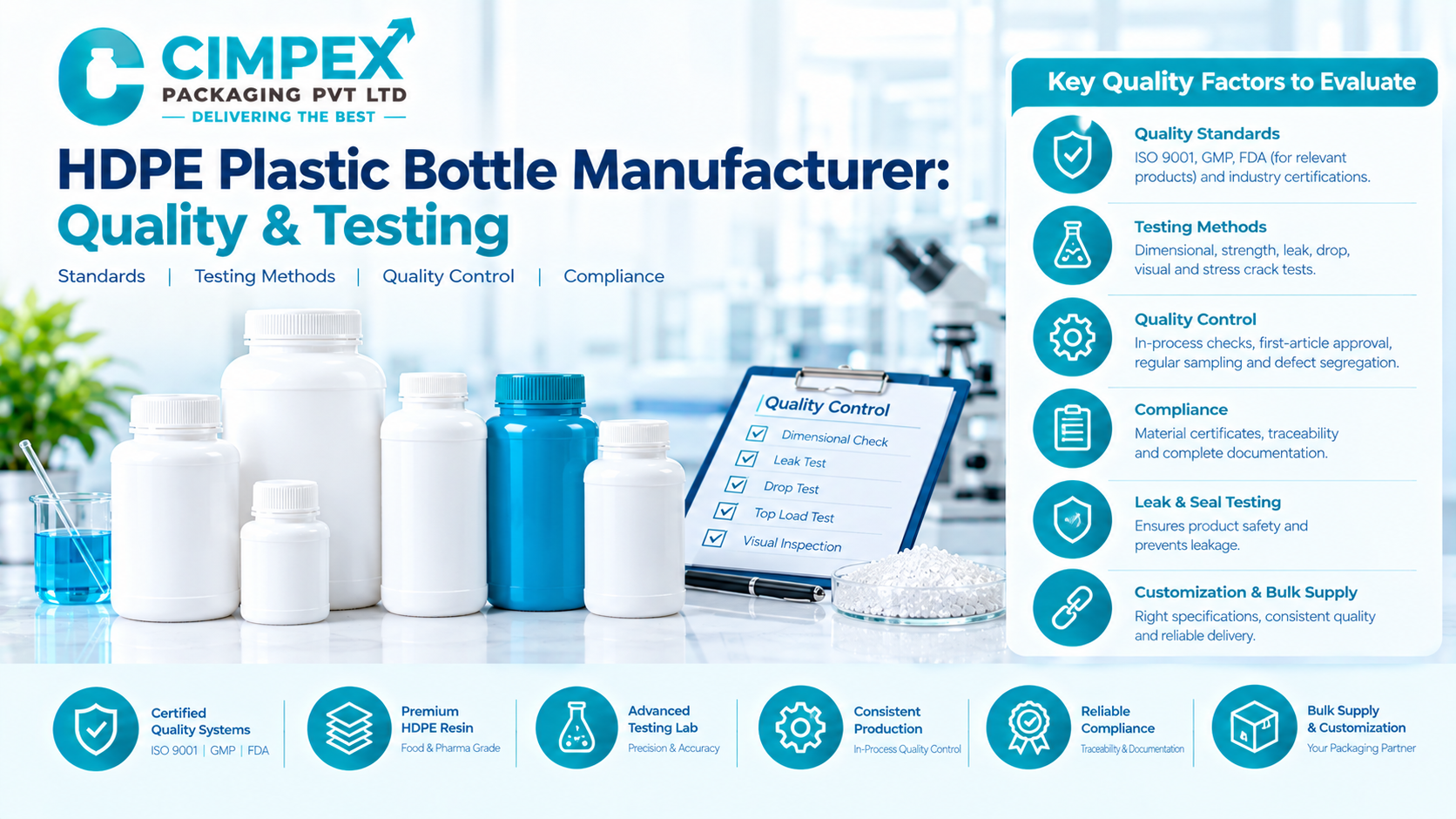
A reliable HDPE plastic bottle manufacturer proves quality through documented standards, repeatable testing and traceable compliance, not through claims. If you buy bottles for pharmaceutical, chemical, personal care or food products, the manufacturer’s quality system decides whether the thousandth bottle matches the approved sample. This guide explains which quality standards to look for, which testing methods matter, how quality control works in practice and how to verify compliance before you commit to a supplier.
Many sourcing mistakes happen because buyers compare quotations instead of the systems behind each HDPE plastic bottle manufacturer. Two suppliers can offer the same capacity and similar prices, yet differ widely in resin control, inspection discipline and documentation. The checks below help you tell them apart.
Why Quality Evidence Matters More Than Price
Bottles are low-cost components attached to high-value products. A leaking closure, an out-of-tolerance neck or a weak wall can damage the contents, stop a filling line or trigger a customer complaint. The cost of those failures usually exceeds any saving from a cheaper supplier.
A capable HDPE plastic bottle manufacturer also reduces your own workload. When inspection records, material certificates and traceability are already in place, your quality team can audit and approve far faster than with a supplier that must assemble documents on request.
HDPE Bottle Quality Standards
HDPE bottle quality standards operate on several levels. Treat them as a layered checklist, not a single badge.
- Quality management system: ISO 9001 is the best-known framework for consistent processes, documentation and continual improvement. The general reference on ISO 9001 explains its role within the ISO 9000 family. Cimpex Packaging lists ISO 9001:2015 among its certifications.
- Good manufacturing practice: GMP-compliant operation is expected for pharmaceutical and food-grade packaging, covering hygiene, process control and records.
- Material standards: Food and pharmaceutical bottles need suitable resin. Cimpex Packaging states that FDA-compliant resins are used for these applications.
- Customer specifications: Many brands add drawings, tolerances and acceptance limits of their own.
A certificate shows that a management system exists and has been audited. It does not replace sample testing, so use both.
Raw Material Control: Where Quality Begins
Bottle performance starts with the resin. Variation in melt flow index, density or purity affects moulding behaviour, wall strength and chemical resistance. Cimpex Packaging describes incoming inspection for these properties and says resins come from certified suppliers, including food-grade and pharma-grade grades. Ask any HDPE plastic bottle manufacturer the same questions:
- Which resin grades are used and from which approved suppliers?
- Is virgin resin used, and is regrind used anywhere?
- What incoming checks are done on each lot?
- Can a batch be traced from finished bottle back to resin lot?
Traceability matters for investigations. If a defect appears months later, batch coding and records allow the cause to be isolated instead of discarding a whole supply.
HDPE Bottle Testing Methods
HDPE bottle testing methods fall into dimensional, structural, performance and visual categories. A balanced programme covers all four.
Dimensional and Weight Checks
Neck finish, thread accuracy, height, diameter, wall thickness and weight uniformity are measured against the drawing. The neck is the most critical area because the closure must engage and seal. Weight checks reveal material distribution problems that are not obvious to the eye.
Strength and Drop Tests
Top-load tests show stacking strength, while drop tests simulate handling. Cimpex Packaging reports checking drop resistance, top-load strength and stress cracking on its bottles. Stress cracking, known more formally as environmental stress cracking, occurs when stress combined with certain chemicals or conditions causes premature cracking, which is relevant to detergents, solvents and agrochemicals.
Visual Inspection
Visual checks look for specks, colour variation, flash, sink marks and deformation. They are quick and catch many cosmetic and functional defects, but they must be performed against an approved reference under consistent lighting.
HDPE Bottle Quality Control on the Production Line
HDPE bottle quality control is the day-to-day discipline that keeps production aligned with the approved sample. In practice it includes in-process sampling, first-article approval, scheduled measurement, defect segregation and recorded results.
What Good Quality Control Looks Like
- First-article approval: The first bottles from a run are checked before volume production continues.
- Scheduled sampling: Bottles are pulled at set intervals for measurement and inspection.
- Defect handling: Non-conforming bottles are separated and recorded.
- Batch records: Each despatch carries identification, inspection data and traceability.
- Corrective action: Recurring defects trigger tooling or process changes, not just sorting.
A credible HDPE plastic bottle manufacturer documents its work. Cimpex Packaging states that each batch is sampled and tested in its in-house laboratory and that despatches include a Certificate of Analysis and traceability records. When evaluating any supplier, ask to see examples of these documents. For pharmaceutical customers, supply in particular depends on consistent records, because quality teams must be able to verify what they receive.
HDPE Bottle Compliance Standards
HDPE bottle compliance standards depend on the product and market. Pharmaceutical packaging faces different expectations from household chemicals, and export markets add their own rules. Chemical packaging in particular can involve safety, labelling and transport requirements that go beyond the bottle itself.
- Food and pharma contact: Resin and process must suit the intended contact and be documented.
- Chemical regulations: REACH and RoHS compliance matters for export. Cimpex Packaging lists both among its credentials.
- Closure requirements: Child-resistant and tamper-evident closures may be required for certain products.
- Dangerous goods packaging: Some chemicals require packaging approved for transport. Confirm requirements with your regulatory adviser.
Compliance is shared between supplier and brand. The HDPE plastic bottle manufacturer provides compliant materials and records, but the brand remains responsible for confirming that the finished pack meets the rules for its own product and market.
HDPE Bottle Leak Testing
HDPE bottle leak testing checks that the bottle and closure together contain the product. It matters most for liquids, chemicals and pesticides, where leakage creates safety and regulatory risk, and for moisture-sensitive products, where ingress causes damage.
Methods vary. Common approaches include inversion with the closure applied, pressure or vacuum tests and checking for loss after transit simulation. The right method depends on the product and closure. Three practical points apply:
- Test the assembled bottle, closure and liner together.
- Repeat testing after drop, vibration or temperature exposure.
- Record closing torque, because over- or under-tightening affects results.
Cimpex Packaging lists leak and drop checks as part of its testing, though the page does not publish the method or pass criteria. Request those if they matter to your product.
Matching Quality Requirements to Your Industry
The right HDPE plastic bottle manufacturer for a pharmaceutical brand is not necessarily the right fit for an agrochemical or household product, because each sector weights quality differently. Pharmaceutical buyers prioritise hygiene, resin documentation and batch traceability. Chemical and agrochemical buyers focus on stress-crack resistance, leak safety and closure performance. Personal care and food brands add appearance, colour consistency and food-contact suitability. Cimpex Packaging lists applications across all of these sectors, plus lubricants, automotive products and veterinary health. Before you shortlist an HDPE plastic bottle manufacturer, rank your own priorities and ask each candidate to show evidence against the top three.
Questions for a Factory Visit
A visit to an HDPE plastic bottle manufacturer’s plant reveals more than any brochure.
- Where is incoming resin stored, and how is it labelled? Clean storage and clear labels reduce mix-ups.
- How are moulds maintained? Worn tooling causes flash and dimensional drift.
- Where do rejected bottles go? Segregated, recorded rejects show real control.
- How are finished bottles packed? Clean, labelled cartons protect quality in transit.
- Who signs off a first article? Clear responsibility shows a working system.
How to Verify an HDPE Plastic Bottle Manufacturer’s Claims
Use a short audit routine:
- Request certificates and confirm they are current.
- Ask for a sample Certificate of Analysis and traceability record.
- Review the HDPE bottle testing methods listed and ask which limits are used.
- Visit the plant or request photographs and a process walk-through.
- Test samples with your own product, closure and filling line.
- Check repeat-order consistency against the approved sample.
Common Mistakes When Choosing an HDPE Plastic Bottle Manufacturer
Even careful buyers vetting an HDPE plastic bottle manufacturer fall into these traps:
- Relying on certificates alone: They show a system, not the performance of your bottle.
- Ignoring the closure: Many leak complaints come from closure mismatch, not the bottle.
- Skipping real-product trials: Chemical resistance and stability should be proved with your formulation.
- Not defining tolerances: A drawing without acceptance limits invites disputes.
- Choosing on price: Unstable quality costs more than a higher unit price.
Conclusion
Choosing an HDPE plastic bottle manufacturer is a decision about systems as much as bottles. Look for layered quality standards, controlled raw materials, defined testing methods, disciplined quality control and clear compliance documentation. Then confirm everything with samples tested on your own product and closure.
If you are preparing a sourcing brief, write down your product type, closure, capacity, tolerances and compliance needs first. Explore the Cimpex Packaging range of HDPE bottles, or contact the team to request samples and documentation for your application.
Frequently Asked Questions
Look for documented quality management such as ISO 9001, controlled resin sourcing, batch testing, traceability and the ability to supply samples and certificates. Confirm that the supplier can explain its dimensional, strength and leak tests and match the compliance needs of your product.
Common standards include ISO 9001 quality management, GMP for pharmaceutical and food-grade packaging, suitable resin compliance for the intended contact and customer specifications. Export markets may add chemical regulations such as REACH and RoHS.
Typical methods include dimensional and weight checks, wall-thickness measurement, visual inspection, top-load and drop tests, stress-crack evaluation and leak testing. The exact programme depends on the product, the closure and the standards that apply.
It involves incoming resin inspection, first-article approval, scheduled in-process sampling, defect segregation, batch records and corrective action. Good quality control keeps every batch consistent with the approved sample and creates the records needed for audits.
Pharmaceutical bottles need suitable resin, hygienic production and traceable records, while chemical bottles may also need compatibility, labelling and transport-related approvals. Requirements vary by country and product, so confirm them with your regulatory adviser.
Leak testing usually involves sealing the bottle with its closure and checking for liquid loss or air escape, using inversion, pressure or vacuum methods. Test the assembled pack, and repeat after drop or transit simulation to confirm the seal holds.
Yes. Reputable manufacturers can provide samples for fit and filling trials, along with material and quality documents. Ask for a Certificate of Analysis, current certifications and traceability records, and test samples with your own product before placing a bulk order.