


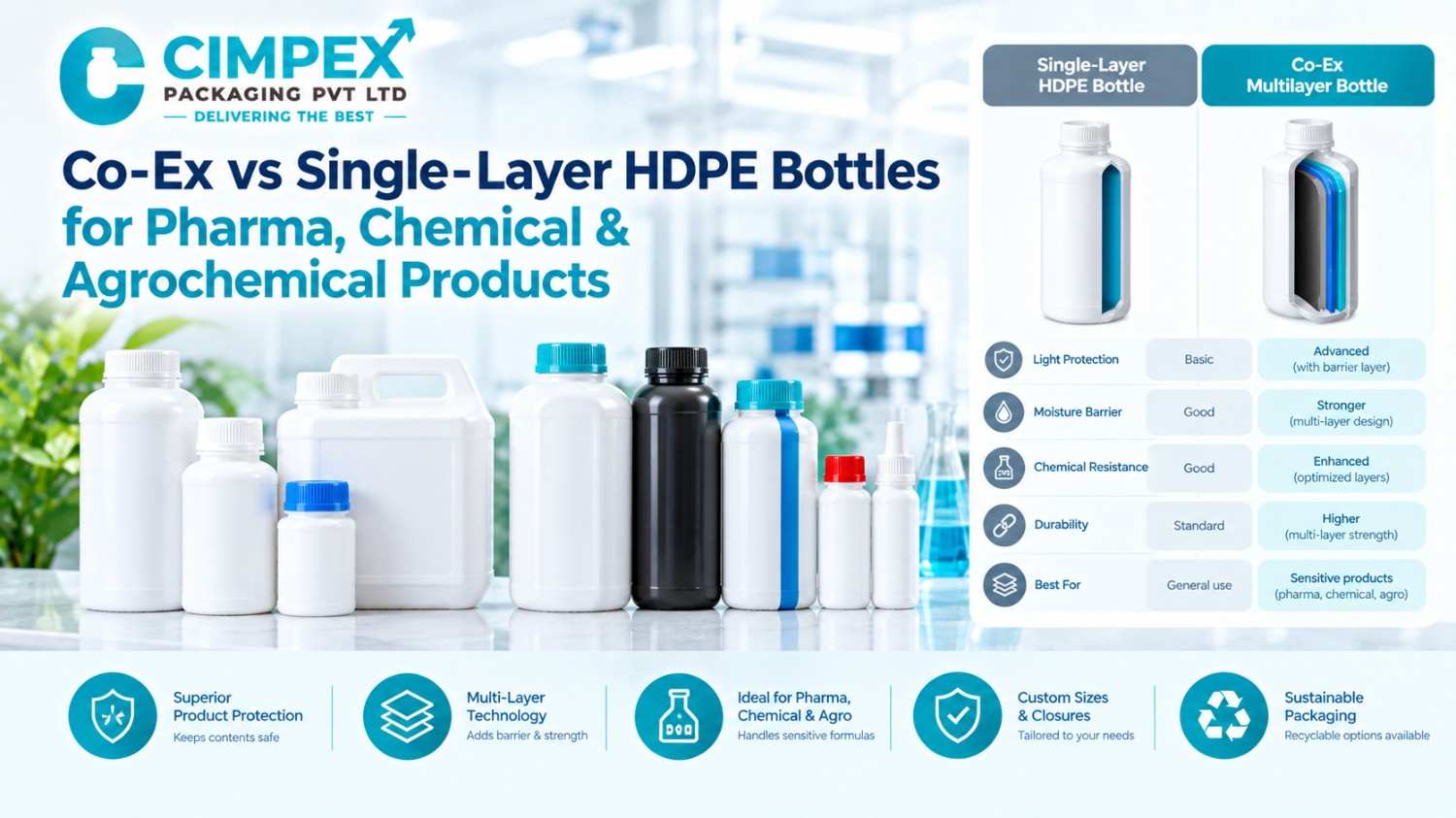
Why Barrier Performance Decides the Choice
Every plastic bottle is slightly permeable. Over months on a shelf, small amounts of oxygen can enter, and some volatile components can escape. HDPE barrier performance is excellent against moisture but modest against oxygen and certain solvents, which is why Co-Ex vs single-layer HDPE bottles becomes a serious question for sensitive products. For a tablet, a good single wall and a tight closure may be all that is needed. For an oxidising liquid or a solvent-based concentrate, multilayer bottle protection can make the difference between a stable product and one that changes during storage.How Single-Layer HDPE Bottles Are Built
A single-layer bottle is moulded from one material, usually high-density polyethylene, so the wall has a uniform structure from the inside to the outside. HDPE offers strong moisture resistance, good impact strength and broad chemical resistance, which is why it is used so widely across pharmaceutical and industrial packaging. The general characteristics of the resin are summarised in this overview of high-density polyethylene. Colour or pigment can be added to block some light, and wall thickness can be adjusted for strength. However, a single wall has natural limits. HDPE is a good moisture barrier, but it allows some oxygen and certain solvents or volatile compounds to pass through over time. That is the gap that Co-Ex construction is designed to address, and it is the central point in any comparison of Co-Ex vs single-layer HDPE bottles.How Co-Ex (Multilayer) HDPE Bottles Work
Co-Ex is short for co-extrusion. In this process, several materials are extruded together to form one wall made of distinct layers. A typical structure places HDPE on the outside and inside for strength, chemical resistance and moisture protection, with one or more functional layers between them. Those functional layers might provide a gas barrier, light blocking or other performance features, depending on the design. The practical result is that Co-Ex vs HDPE bottles is not a question of one material being better in general. It is a question of whether your product needs more protection than one layer can offer. Multilayer vs single-layer HDPE bottles differ mainly in barrier capability, complexity and cost, and the right answer to multilayer vs single-layer HDPE bottles changes from one formulation to the next. If you are evaluating a multilayer range, Cimpex Packaging lists multilayer bottles alongside its standard HDPE and PP products.The Role of the EVOH Barrier Layer
Ethylene vinyl alcohol, known as EVOH, is one of the best-known barrier materials in plastic packaging because it limits oxygen transmission very effectively. You can read more in this general reference on EVOH, though the key practical point is simple: the EVOH barrier layer is sensitive to moisture, so it is normally sandwiched between HDPE layers that protect it. This is why the barrier layer, the adhesive layers and the HDPE outer layers must all be controlled together. Good adhesive layers bond the materials together so the wall behaves as a single structure. The quality of that bonding, and the evenness of each layer, determines how well the bottle performs in real use.Co-Ex vs Single-Layer HDPE Bottles: Side-by-Side Comparison
| Factor | Single-layer HDPE | Co-Ex (multilayer) HDPE |
| Wall structure | One material | Several bonded layers |
| Moisture protection | Strong | Strong, with HDPE outer layers |
| Oxygen and gas barrier | Limited | Improved when a barrier layer such as EVOH is included |
| Light protection | Depends on colour or pigment | Can include a dedicated light-blocking layer |
| Complexity and cost | Simpler, generally lower cost | More complex, generally higher cost |
| Best suited for | Tablets, powders, many oral liquids, general chemicals | Oxygen-sensitive, volatile or aggressive products |
Single-Layer HDPE Bottle Benefits and Limits
Single-Layer HDPE Bottle Benefits
The main single-layer HDPE bottle benefits are simplicity, cost efficiency and proven performance. A single material is easier to mould consistently, easier to recycle in many collection systems and well understood by formulators and regulators. For many products, including tablets, powders and a large range of liquids, single-layer HDPE bottle benefits are more than enough.- Moisture protection suitable for most dry and liquid oral products.
- Straightforward production, which supports consistent quality and bulk supply.
- Lower packaging cost for products that do not need extra barrier performance.
- Wide compatibility with standard caps, liners and dispensing parts.
Where Single-Layer Bottles Fall Short
- Limited oxygen barrier, a known limit of HDPE barrier performance, for formulations that oxidise.
- Possible permeation of some solvents or fragrances over a long shelf life.
- Light protection that depends on pigments alone.
Co-Ex Bottle Benefits and Applications
Co-Ex Bottle Benefits
The strongest Co-Ex bottle benefits are better barrier control and design flexibility. By combining layers, a bottle can resist oxygen ingress, reduce loss of volatile components and protect against light, while keeping the strength of HDPE on the outside. This extends the range of products that can be packed in plastic instead of glass. HDPE barrier performance improves when a barrier layer is added, because each layer handles a different job. The Co-Ex bottle benefits are strongest where a single wall has already shown weaknesses in stability testing.- Better protection for oxygen-sensitive or light-sensitive formulations.
- Reduced permeation of certain volatile or aggressive contents.
- Potential to protect product quality across a longer shelf life, subject to testing.
- Lightweight, shatter-resistant packaging compared with glass.
Co-Ex Bottle Applications
Typical Co-Ex bottle applications include agrochemical formulations, specialty chemicals, certain liquid pharmaceuticals and light-sensitive products. Cimpex Packaging has published a separate guide on UV resistant Co-Ex bottles for chemical and pharma products, which is useful if light protection is your main concern. Co-Ex bottle applications in agriculture are growing in relevance because many pesticide and crop-protection formulations contain solvents that can interact with a single wall.Barrier Packaging for Chemicals and Pharmaceuticals
Barrier Packaging for Chemicals
Barrier packaging for chemicals must manage chemical compatibility, vapour loss and safe handling, and the Co-Ex vs single-layer HDPE bottles decision is often driven by these factors. Industrial cleaners, solvent-based products and agrochemicals can behave differently in different plastics, so test the filled bottle under realistic storage conditions. Barrier packaging for chemicals also depends heavily on the closure, because a leaking cap defeats even the best wall structure.Barrier Packaging for Pharmaceuticals
Barrier packaging for pharmaceuticals protects potency, appearance and shelf life, and multilayer bottle protection is one tool among several for achieving that. For tablets and capsules, single-layer HDPE with a good closure is often adequate. For oxygen-sensitive liquids or products that need stronger multilayer bottle protection, a Co-Ex structure may be justified. In every case, stability studies on the actual formulation, with the actual bottle and cap, are the basis for approval.Advantages and Disadvantages of Co-Ex vs Single-Layer HDPE Bottles
Co-Ex Bottles
- Advantages: stronger barrier performance, light protection options and wider product compatibility.
- Disadvantages: higher cost, more complex tooling and processing, and more careful quality control needed for layer consistency.
Single-Layer HDPE Bottles
- Advantages: simpler, economical, easy to source in bulk and suitable for many products.
- Disadvantages: limited gas barrier and less protection against aggressive or volatile contents.
How to Choose Between Co-Ex vs Single-Layer HDPE Bottles
Start with your product, not the bottle. List the risks: oxygen, light, moisture, solvent loss, fragrance loss and contact with the plastic itself. Then compare the barrier needs with the construction options. A supplier that makes both constructions can advise on multilayer vs single-layer HDPE bottles without pushing one over the other, which is a useful sign when you shortlist partners.- If moisture is your main concern, single-layer HDPE is often sufficient.
- If the formulation oxidises or loses volatile components, evaluate multilayer bottle protection.
- If the product is light-sensitive, consider pigmented single-layer or Co-Ex with a light-blocking layer.
- Common mistake: specifying Co-Ex for every product. Extra layers add cost and are unnecessary when stability data shows single-layer HDPE performs well.
Mistakes to Avoid
In the Co-Ex vs HDPE bottles debate, a common error is choosing a barrier bottle because it sounds safer, without testing whether the product actually needs it. The opposite error is staying with a single wall for a formulation that has already shown oxidation or solvent loss. Another is judging only the bottle: the cap, liner and neck finish also influence barrier packaging performance, so test the complete pack. Finally, check that the supplier can control layer thickness consistently across production batches.Frequently Asked Questions
In Co-Ex vs single-layer HDPE bottles, single-layer HDPE bottles have one material in the wall, while Co-Ex bottles have several bonded layers made by co-extrusion. The extra layers can add oxygen, light or solvent barrier performance, which suits sensitive formulations that a single HDPE wall may not protect adequately.
Not always. Co-Ex vs HDPE bottles depends on the product. Co-Ex bottles give stronger barrier protection, but single-layer HDPE is simpler, cheaper and fully adequate for many tablets, powders and liquids. Stability data should guide the decision.
An EVOH barrier layer is a thin layer of ethylene vinyl alcohol placed between HDPE layers to limit oxygen passing through the bottle wall. Because EVOH is sensitive to moisture, it is normally protected on both sides by HDPE.
Choose a multilayer bottle when your product is oxygen-sensitive, light-sensitive, volatile or chemically aggressive, and a single wall fails stability testing. If a single-layer bottle performs well in stability studies, extra layers are usually unnecessary.
Yes, for certain liquid pharmaceuticals and sensitive formulations that need extra barrier protection. Many tablets and oral liquids are packed in single-layer HDPE, so the Co-Ex vs single-layer HDPE bottles choice depends on the formulation. Barrier packaging for pharmaceuticals should always follow stability data. Confirm the choice through stability and compatibility testing with your formulation and closure.
Co-Ex bottle applications often include agrochemical formulations; they are widely considered because many contain solvents that can interact with a single wall. Confirm compatibility with your exact formulation through testing, and check closure and liner performance as well.
Recyclability depends on the layer structure and local collection systems. Single-layer HDPE is generally easier to recycle, while multilayer bottles may need specialised handling. Ask your supplier about design choices that balance barrier performance with end-of-life options.