


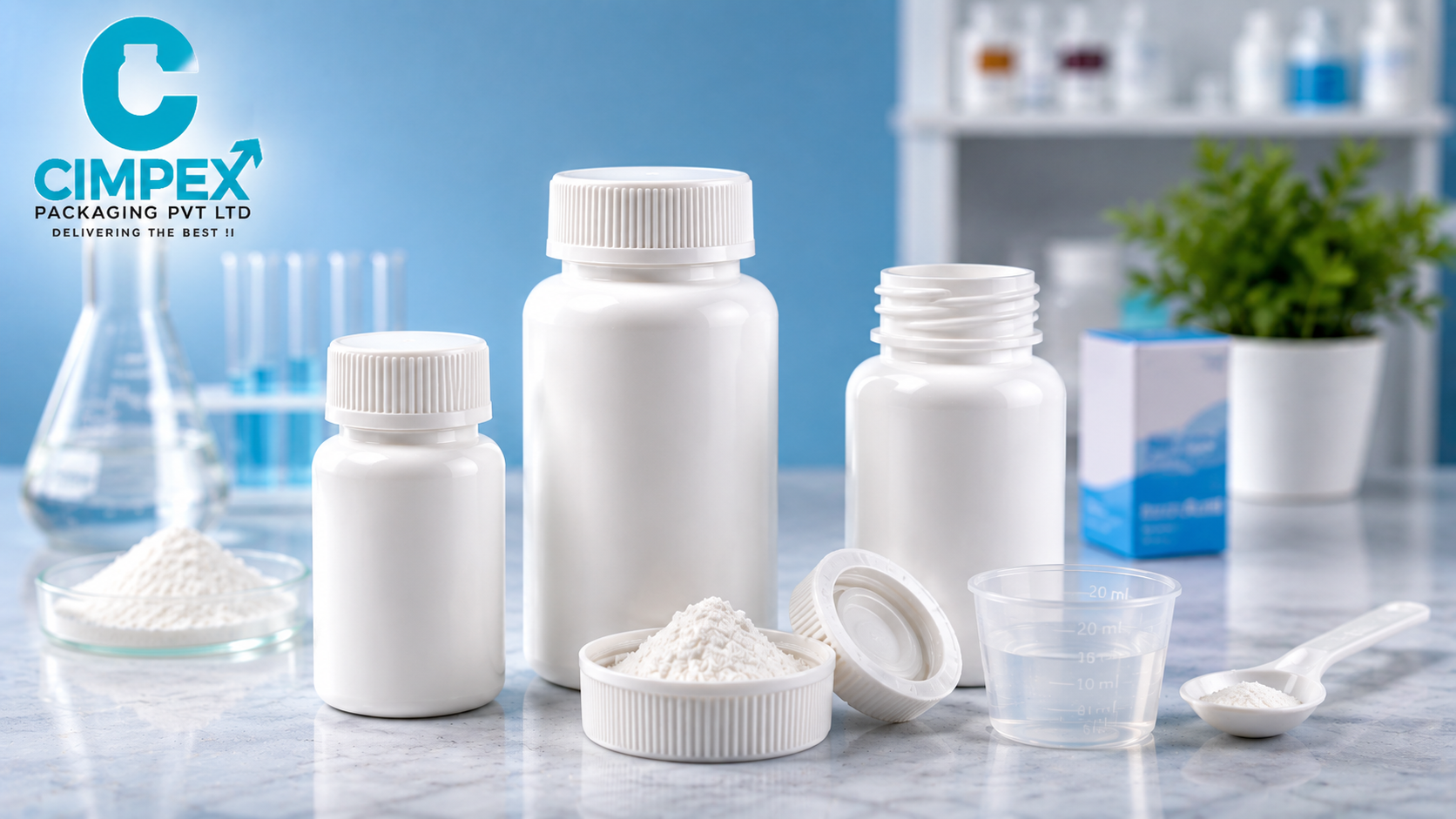
Procurement teams often start by comparing bottle prices, but the real work of vetting a dry syrup bottle manufacturer in India happens at the specification stage, before any quotation is requested. A bottle that looks identical on a spec sheet can behave differently once powder is filled, water is added, and a caregiver shakes it at home. Cimpex Packaging manufactures HDPE bottles for reconstitutable formulations, and this guide covers the design and dosing factors that determine whether a bottle performs in the field.
What Is a Dry Syrup Bottle?
A dry syrup bottle holds pharmaceutical powder or granules that a pharmacist or caregiver reconstitutes with water before dosing. Unlike a standard liquid bottle, it moves through an empty state, a powder-fill state, and a reconstituted-liquid state. A dry syrup bottle manufacturer in India engineers internal geometry, neck finish, and closure around that transition.
Why Is Bottle Design Important for Dry Syrup Packaging?
For a dry syrup bottle manufacturer in India, design affects whether a formulation reconstitutes evenly, whether the closure seals reliably, and whether a caregiver can dose accurately at home. Get these wrong and the result is complaints, stability failures, or inconsistent dosing.
Capacity and Internal Volume
Internal volume must account for both the powder-fill weight and the water added during reconstitution, with room left for shaking. A dry syrup bottle sized too tightly around the final volume leaves little space for mixing, often causing poor powder dispersion.
Headspace and Reconstitution
Headspace is the empty space above the liquid line once reconstituted, existing so contents can be agitated without spilling. Too little headspace forces cautious shaking, leaving the suspension incompletely mixed and the dose inconsistent dose to dose.
Bottle Shape and Handling
A bottle too narrow is hard to grip while shaking, and an unstable base can tip during pouring, especially when a caregiver is also holding a measuring cup.
How Does Material Selection Affect Dry Syrup Bottles?
Material choice, guided by an experienced dry syrup bottle manufacturer in India, determines how well the bottle protects moisture-sensitive powder and how it performs on filling lines.
Why HDPE Is Commonly Used
HDPE is widely used for pharmaceutical containers because of its comparatively low moisture vapour transmission rate, along with the rigidity needed to hold shape on automated filling and capping equipment. These properties matter more for a dry syrup bottle than for many other pack types, since the powder inside is actively hygroscopic before reconstitution.
Pharma HDPE Bottle Considerations
A pharma HDPE bottle for dry syrup use should be evaluated for resin consistency, wall uniformity, and compatibility with the closure and liner system, since resin variation between batches can change how a cap seats.
How Do You Choose Between 30ml and 60ml Bottles?
A dry syrup bottle manufacturer in India typically bases capacity on the prescribed dose, the course length, and how much reconstituted liquid the formulation requires, not on whichever size is in stock.
30ml Dry Syrup Applications
A 30ml dry syrup pack is generally considered for lower-dose paediatric formulations or shorter courses, where a compact bottle also supports easier handling. Internal space here is more limited, so headspace deserves close attention during development.
60ml Dry Syrup Bottle Applications
A 60ml dry syrup bottle is typically considered where the formulation needs a larger reconstituted volume or the treatment course runs longer. A dry syrup bottle manufacturer in India will generally allow more comfortable headspace at this size, though this should still be confirmed through trials.
30ml vs 60ml Dry Syrup Bottle Considerations
| Factor | 30ml Dry Syrup Bottle | 60ml Dry Syrup Bottle |
| Typical consideration | Smaller formulation requirements | Larger reconstituted volume |
| Internal space | More limited | Greater capacity |
| Headspace | Must be carefully evaluated | More room may be available |
| Handling | Compact format | Larger body may be required |
| Final selection | Confirm through trials | Confirm through trials |
Why Are Neck Finish and Closure Compatibility Important?
The neck finish is the interface between the bottle and every other component in the pack, so a mismatch is something any dry syrup bottle manufacturer in India needs to catch early.
Screw Closures
Screw closures need thread dimensions that match the neck finish precisely; a loose fit compromises the seal and an overly tight fit can crack the neck during high-speed capping. Suppliers of caps and closures validate this fit through capping trials before a design is approved.
Tamper-Evident Options
Tamper-evident features give visible proof that a dry syrup bottle has not been opened before it reaches the patient, which matters for regulatory expectations and consumer trust. These need validation against the actual closure torque used on the filling line.
Dosing Compatibility
The closure also has to accommodate whatever dosing accessory accompanies the pack, whether a measuring cup, syringe adapter, or dropper insert. Cimpex offers measuring cups and caps designed to pair with its bottle range, simplifying this check.
How Does Reconstitution Affect Bottle Design?
Reconstitution puts the most stress on a dry syrup bottle’s design, since powder, water, closure, and bottle wall all interact at once. The bottle must withstand vigorous shaking without deforming, the closure must reseal reliably after each dose, and the geometry should avoid pockets where undissolved powder collects. A dry syrup bottle manufacturer in India that tests reconstitution behaviour during development, rather than only at final validation, catches these issues earlier and more cheaply.
What Quality Checks Should a Manufacturer Perform?
Consistent quality checks separate a reliable dry syrup bottle manufacturer in India from one that only looks reliable on paper. Buyers evaluating pharma packaging more broadly can also review this pharma bottle manufacturer guide for related quality and compliance context.
Dimensional Inspection
Dimensional inspection confirms neck finish, wall thickness, and geometry stay within tolerance, keeping capping and filling equipment running without jams.
Leakage and Closure Testing
Leakage testing confirms the cap and liner hold a reliable seal under normal handling and transport, important for a bottle tipped and shaken repeatedly during use.
Material and Visual Checks
Visual inspection catches surface defects automated checks sometimes miss, while material verification confirms the resin matches what was specified for the pharma HDPE bottle order.
Pre-Approval Checklist
Before approving a dry syrup bottle from any dry syrup bottle manufacturer in India, teams should confirm the following:
- Powder-fill quantity and its match to internal bottle volume
- Final reconstitution volume and resulting fill level
- Headspace available for shaking and mixing
- Bottle material and its moisture-barrier performance
- Neck finish and its compatibility with the chosen closure
- Closure torque and tamper-evidence performance
- Compatibility with the intended dosing accessory
- Fit with existing filling-line and capping equipment
- Storage requirements, including temperature and humidity exposure
- Transportation requirements and resistance to handling stress
What Should Pharmaceutical Companies Look for in a Dry Syrup Bottle Manufacturer in India?
Selecting the right dry syrup bottle manufacturer in India involves more than comparing per-unit pricing across quotations.
- Confirm whether dedicated pharma tooling is used, or lines are shared with cosmetic and FMCG production
- Ask how resin batches are verified for consistency between runs
- Review the approach to dimensional and leakage testing
- Check whether sample units are available for trial reconstitution before a full order
- Understand how design changes are supported if a dosing requirement shifts later
A dry syrup bottle manufacturer in India that treats these as ongoing practices, rather than one-time claims, is generally easier to work with long term.
When Is a Customized Dry Syrup Bottle Useful?
Customization is worthwhile when a standard catalogue bottle does not match the formulation’s reconstitution behaviour, dosing accessory, or the filling line’s tooling. This might mean adjusting internal volume, modifying the neck finish, or altering wall thickness for a moisture-sensitive formulation. A pharma HDPE bottle can often be adapted without a complete redesign if the dry syrup bottle manufacturer in India is engaged early.
When Should You Not Select a Dry Syrup Bottle?
Not every bottle that looks acceptable on a data sheet is ready for approval.
- The formulation has not yet been tested with the specific bottle and closure combination
- Headspace has not been confirmed as adequate for shaking and mixing
- Closure compatibility, including torque and liner performance, has not been validated
- The bottle has not been trialled on the actual filling and capping line intended for production
- Reconstitution testing under realistic conditions has not been completed
- The supplier’s specifications are vague or inconsistent across communications
Approving a bottle before these points are resolved tends to shift problems downstream, where they become far more expensive to fix.
Why Choose Cimpex Packaging as a Dry Syrup Bottle Manufacturer in India?
Cimpex Packaging manufactures HDPE and PP bottles, jars, and closures from its facility in Baddi, Himachal Pradesh, serving pharmaceutical, nutraceutical, cosmetic, and chemical brands. Cimpex works across the range needed for reconstitutable packs, including bottles, measuring cups, and closures, letting buyers source a matched system rather than coordinate multiple vendors. Manufacturing and quality practices are outlined on the process and manufacturing page.
Background on the company, including its facility and industry focus, is available on the About Us page.
Need the right bottle for your dry syrup formulation?
Contact Cimpex Packaging to discuss capacity, material, neck finish, closure, and quantity requirements for your next production run.
Conclusion
Capacity determines how a formulation fits within the bottle, headspace determines whether it can be mixed properly, and material selection determines how well the powder stays protected before reconstitution. Closure compatibility ties these elements together into a working seal, and testing confirms the combination performs as designed. Choosing the right dry syrup bottle manufacturer in India means finding a partner who treats these factors as connected decisions rather than separate line items on a quote.
Frequently Asked Questions
1. What is a dry syrup bottle used for?
It holds pharmaceutical powder or granules reconstituted with water before dosing, commonly used for paediatric antibiotics and short-course liquid medications.
2. How do I choose the correct dry syrup bottle capacity?
Base it on prescribed dose, course length, and reconstituted volume, then confirm headspace with your dry syrup bottle manufacturer in India through reconstitution trials.
3. Is a 30ml dry syrup bottle suitable for every formulation?
No. A 30ml format suits smaller, shorter-course formulations; a dry syrup bottle manufacturer in India can advise when larger volumes need more headspace.
4. When should I choose a 60ml dry syrup bottle?
When the formulation needs a larger reconstituted volume or the treatment course requires more total doses from one pack.
5. Why is HDPE commonly used for pharmaceutical bottles?
It offers a comparatively low moisture vapour transmission rate and enough rigidity for automated filling and capping lines in pharma packaging.
6. What is a pharma HDPE bottle?
A container moulded from high-density polyethylene, selected for pharmaceutical use because of its moisture barrier properties and consistent processing.
7. Why is headspace important for dry syrup packaging?
It gives room for shaking after reconstitution; without enough of it, powder can clump and dosing becomes inconsistent across treatment.
8. How do I select a dry syrup bottle manufacturer in India?
Evaluate a dry syrup bottle manufacturer in India on tooling dedication, resin consistency, testing practices, and willingness to support trials.