


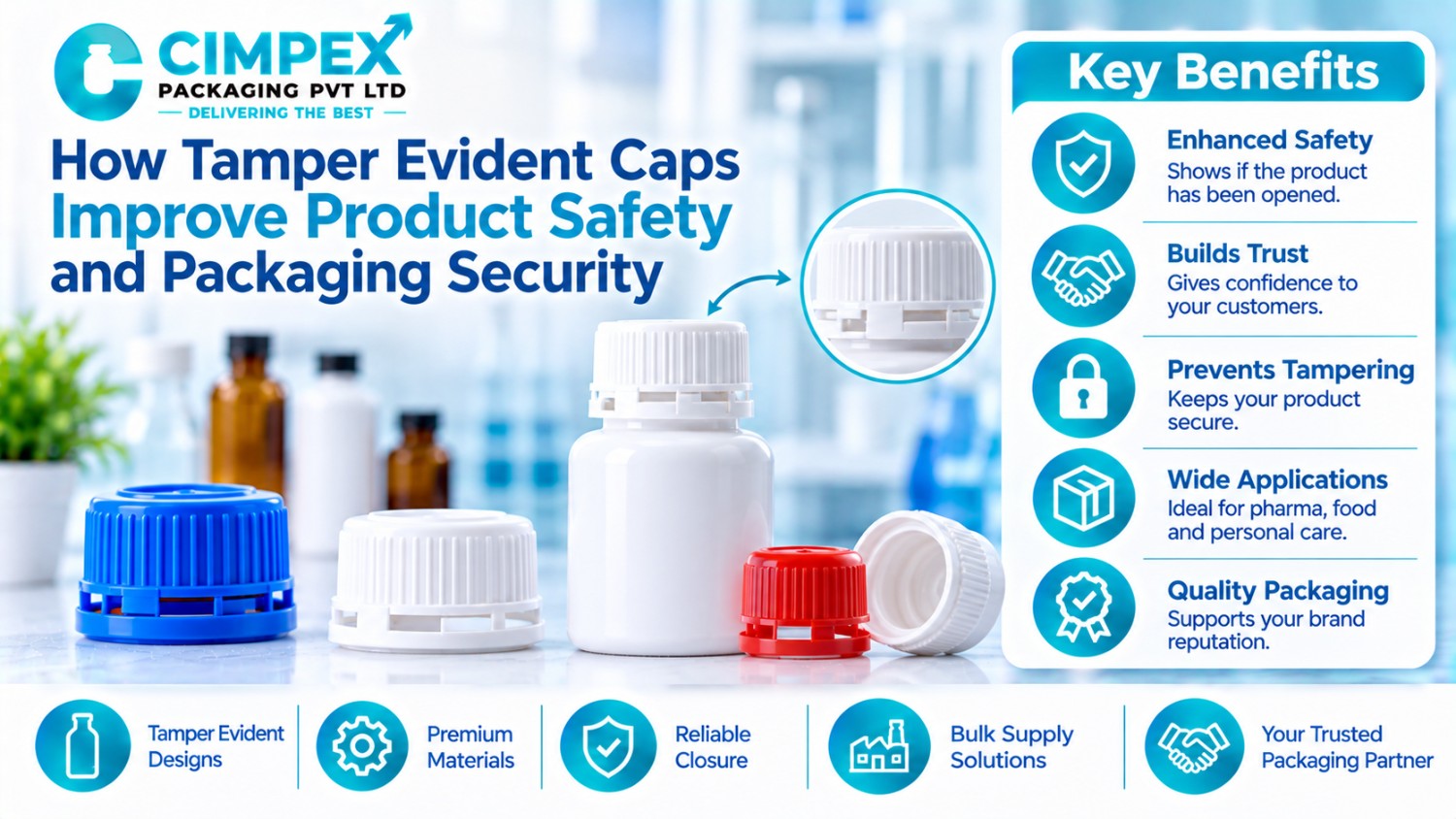
What Tamper Evident Caps Actually Do
A tamper evident cap carries a feature that is permanently altered the first time the pack is opened. Usually this is a band connected to the base of the cap by small bridges. Turning the cap breaks these bridges, and the band either stays on the neck of the bottle or separates from the cap. Once that happens, the damage cannot be hidden easily, so anyone who sees the pack can tell it has been opened. It is worth being precise about terminology. Tamper evident caps give visible proof of opening. They do not make a pack impossible to open, which is why the term “tamper proof” is used loosely in the market. In practice, tamper proof bottle caps and tamper evident designs both aim to reduce the risk of undetected interference, but no closure can claim to be completely immune to a determined attempt. The aim is to make interference obvious.Why Packaging Security Matters
Packaging is the last line of defence between a manufacturer and the consumer. Between the filling line and the user’s hands, a product passes through warehouses, transport, distributors and retail shelves. Each stage is an opportunity for accidental opening, deliberate tampering or counterfeiting. Tamper evident caps address part of this risk by making any opening visible. The modern approach to tamper-evident packaging in many markets traces back to the Chicago tampering incidents of 1982, which led regulators in the United States to introduce tamper-evident packaging requirements for many over-the-counter medicines. Since then, the idea has spread well beyond pharmaceuticals. A general explanation of the concept is available in this overview of tamper-evident packaging. The exact legal requirements depend on the product category and the country, so brands should confirm what applies to them.Common Types of Tamper Evident Closures
Several mechanisms are used, and the best choice depends on the product, the bottle neck finish and the way the pack is filled and handled.Break-Away Band Caps
The most familiar design is a screw cap with a ring at the bottom. The ring stays locked on the bottle neck when the cap is first unscrewed, and the broken bridges make it obvious that the pack has been opened. These caps are practical for high-volume filling because they are applied in the same way as ordinary screw caps.Induction Seals and Liners
An induction-sealed foil liner bonds to the bottle rim and must be peeled or punctured before use. It is often combined with a band cap, giving two separate signs of opening: the foil and the band. This is a common approach for medicines, supplements and liquid products that require a better barrier.Shrink Bands and Neck Seals
A printed or clear sleeve around the cap and neck must be torn before opening. These are flexible and easy to brand, though they add a secondary application step and an extra component to manage.Snap-Lock and Flip-Top Designs
Some dispensing closures use a tab or strip that must be removed before first use. These suit products where a hinged lid or controlled dispensing is needed.Where Tamper Evident Caps Make the Biggest Difference
Not every product carries the same level of risk, but the benefits are clearest in categories where the consumer ingests, applies or relies on the contents.- Medicines and healthcare liquids: Patients depend on the product being unopened and unaltered, and regulators in many markets expect visible evidence of opening on certain categories.
- Nutraceuticals and supplements: Powders, tablets and capsules are consumed directly, and consumers increasingly look for visible assurance before purchase.
- Food and beverages: Closures help retail and e-commerce buyers feel confident that products have not been opened in transit.
- Household and industrial chemicals: An intact band signals that the contents have not been diluted, replaced or partly used.
Material and Design Considerations
Most tamper evident caps used with plastic bottles are moulded from polypropylene (PP) or high-density polyethylene (HDPE). PP is widely used for its stiffness and surface finish, while HDPE is valued for chemical resistance and a slightly softer feel. A reliable tamper evident cap manufacturer in India should be able to explain which resin suits your product and bottle, rather than offering one standard answer. Design details matter just as much as the resin. In tamper evident caps, the strength of the bridges must be balanced: too weak and bands break during filling or transport, too strong and consumers struggle to open the cap. Thread fit, liner type, neck finish compatibility and torque values all influence whether the cap performs well in real use.Checklist for Cap Design Review
- Neck finish compatibility with your bottle, including thread profile and diameter
- Bridge strength tested for both opening ease and transit durability
- Liner or seal type suited to the product, for example induction, pulp-board or wad
- Child-resistant requirements, where applicable, since this is a separate function from tamper evidence
- Colour matching, printing or embossing needs for branding
Comparing Plastic Closure Options
Different products call for different closure systems, and buyers looking for tamper proof bottle caps will usually end up choosing one of the designs below. The table below summarises the qualitative differences between common approaches.| Closure type | Main benefit | Points to consider | Typical use |
| Band cap alone | Simple, fast to apply on standard lines | Evidence depends on the band alone | General packaging, food, household goods |
| Band cap with induction liner | Two visible signs of opening, better barrier | Needs induction sealing equipment | Medicines, supplements, liquids |
| Shrink band over cap | Strong branding opportunity | Extra application step | Retail products needing visible seals |
| Snap-lock or tab closure | Controlled dispensing | Design varies by product | Droppers, sprays, dispensing packs |
How Plastic Tamper Evident Caps Support Brand Trust
Plastic tamper evident caps do more than protect the product. They protect reputation. A consumer who finds a broken band can return the pack immediately, and a retailer who notices damage can remove stock before it reaches shoppers. Brands that adopt a clear opening indicator also make it harder for counterfeiters to refill packs without visible signs. The commercial benefits are practical rather than dramatic. A reliable closure reduces complaints about leakage, reduces the risk of unnoticed opening in transit and gives retail and export customers confidence in the pack. Plastic tamper evident caps also offer production advantages over metal alternatives: they are lighter, can be moulded in various colours and are compatible with automated capping lines.Choosing a Supplier for Tamper Evident Closures
A tamper evident closures manufacturer should be assessed on consistent moulding quality, not just price. Request samples of the tamper evident caps and test them on your own filling line with your own bottles. Look at how the band behaves under normal capping torque, whether threads engage cleanly and whether the liner seats correctly. Process discipline matters as well. Ask how the tamper evident cap manufacturer in India controls resin lots, inspects dimensions, manages mould maintenance and records quality checks. For products that are regulated, request documentation on materials and change control, so that you are informed before any resin, mould or process changes.Pharmaceutical Bottle Caps: Extra Points to Verify
Pharmaceutical bottle caps need to meet more demanding requirements than general-purpose closures. In addition to tamper evidence, they often need to provide a controlled seal for moisture-sensitive products, remain compatible with the formulation and, in some cases, include child-resistant features. Cleanliness during moulding and packing is also a priority, since the cap contacts the product or the container rim. Any tamper evident closures manufacturer serving this sector should expect audits and documentation requests. For pharmaceutical bottle caps, confirm the resin grade, request material certificates, check the liner specification and run compatibility and stability trials with the finished product. These steps are standard practice and help avoid problems that only become visible after launch.Selecting Plastic Bottle Caps and Closures for Your Product
The broader range of plastic bottle caps and closures available today makes selection harder, not easier. A practical sequence is to define the product and risk level first, then the bottle neck finish, then the closure type, and only afterwards the colour and branding details. Rushing this sequence often leads to a cap that looks right but does not fit properly or perform under real conditions. Remember to evaluate the closure together with the bottle. A well-made cap on a poorly finished neck can still leak or fail to show tampering reliably. A tamper evident closures manufacturer that can also supply bottles is usually in a better position to match the two components.Conclusion
Tamper evident caps improve product safety by making unauthorised opening visible, which protects consumers, supports retailers and reduces risk for the brand. Their value depends on getting the details right: a suitable resin, well-balanced band strength, correct neck finish compatibility, the right liner and a supplier that controls quality from lot to lot. Distinguishing tamper evidence from child resistance, and checking regulatory expectations for your own category, helps avoid avoidable mistakes. The same discipline applies to all plastic bottle caps and closures in your range. Before you select tamper evident caps, review your product’s risk level, bottle neck finish, filling method and market requirements, then test samples under real conditions. Working with an established tamper evident cap manufacturer in India makes it easier to test, qualify and audit what you buy. To discuss cap options for your bottles, you can explore the closure range at Cimpex Packaging or contact the team for guidance based on your product and packaging requirements.Frequently Asked Questions
A tamper evident cap is a closure with a feature, usually a breakable band or seal, that visibly changes when the pack is first opened. It lets consumers, retailers and manufacturers see whether a product has been opened since filling. It does not stop opening but makes interference obvious.
Tamper evident caps show clear proof that a pack has been opened. “Tamper proof” is often used loosely, but no closure is completely impossible to open. In practice, tamper proof bottle caps and tamper evident designs both aim to make unauthorised opening visible and difficult.
Medicines, nutraceuticals, food and beverages, and many household chemicals commonly use them. Legal requirements depend on the product category and the market, so check your local regulations. Even where not mandatory, many brands choose them to build consumer confidence and protect their reputation.
Most of these closures are moulded from polypropylene or high-density polyethylene. PP offers stiffness and a good finish, while HDPE offers chemical resistance and a softer feel. The right choice depends on the product, the bottle neck and the sealing method.
No. Tamper evidence shows that a pack has been opened, while child resistance makes it harder for young children to open the pack. A closure can include both features, but each must be specified and tested separately for the intended product.
Yes. Colour, thread size, liner type, texture and band design can be adapted to suit the bottle and product. Custom designs may need new tooling and validation, so share your neck finish, filling method and product details with the supplier early in the project.
Check moulding quality, material traceability, change-control practices and the ability to match your bottle neck finish. Test tamper evident caps on your own filling line, and compare how consistently the bands break and the threads engage across several lots before placing a bulk order.