


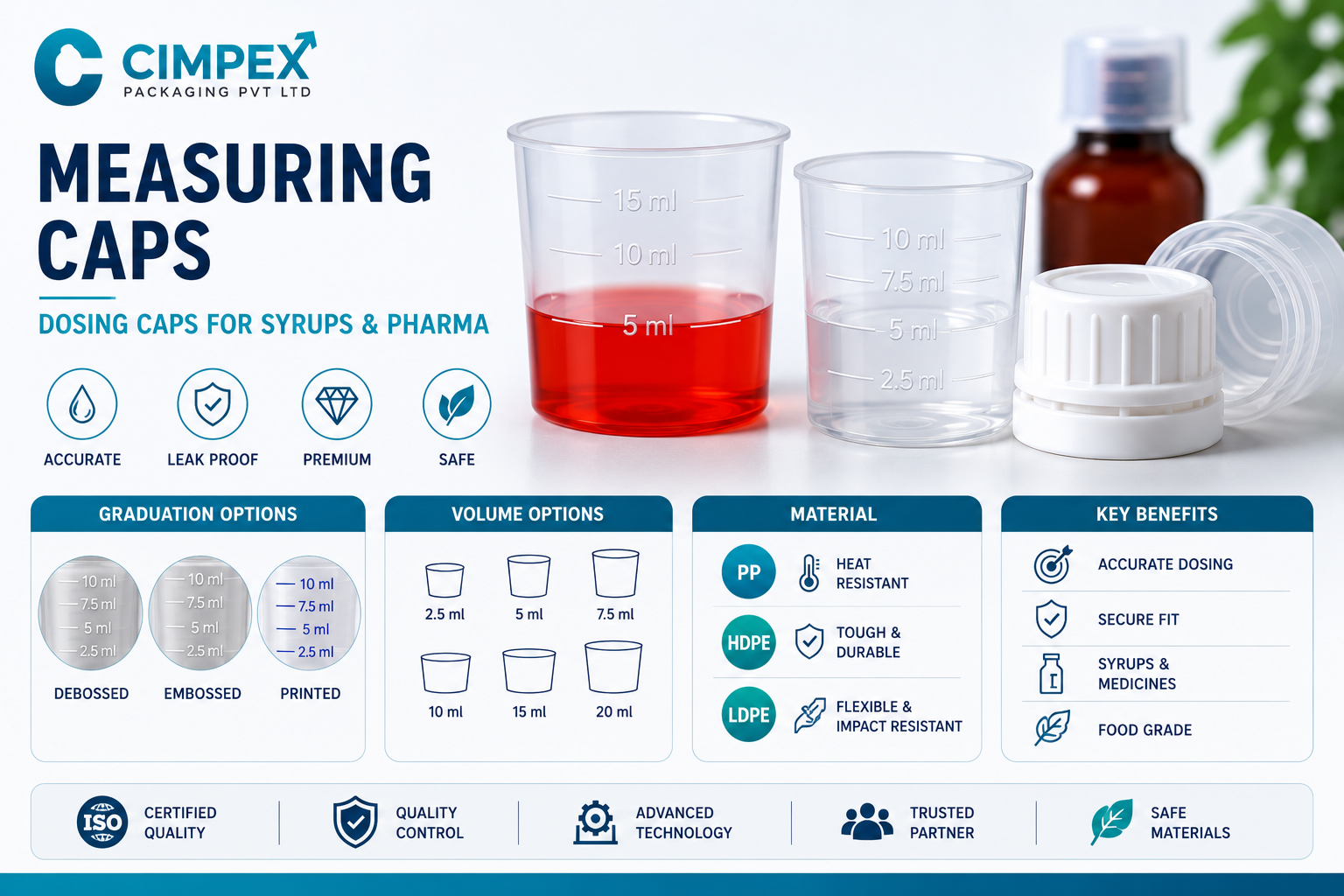
A measuring cap is the only part of a syrup pack a patient actually reads. If the 5ml line is invisible under kitchen light, or the cup holds 5.6ml when it says 5, the dose is wrong and the brand carries the consequence. That is why picking a measuring caps manufacturer sits with packaging development and QA, not just with procurement. Cimpex Packaging moulds measuring cups & caps in PP, HDPE and LDPE at Baddi for pharma, nutraceutical and FMCG brands, and this guide sets out what a serious measuring caps manufacturer should be able to demonstrate before you approve a tool.
Why a Measuring Cap Is a Dosing Device, Not an Accessory
Regulators and paediatricians treat the cup as part of the dosing system. That framing changes what you specify.
- Volume accuracy has to hold across the graduation range, not only at the brim.
- Legibility must survive washing, repeated use and a poorly lit room.
- Material compatibility matters because the cup contacts a sugar- or sorbitol-heavy syrup, sometimes with ethanol or preservatives.
- Fit must be secure enough to travel and easy enough for an elderly patient to remove.
Get any one of those wrong and you get complaints that look like formulation problems. A measuring caps manufacturer that has moulded for regulated products will raise all four before you ask.
What Should You Expect From a Measuring Caps Manufacturer?
Dosing caps for pharma are held to tighter expectations than FMCG cups, and four technical areas separate a moulder from a packaging partner.
1. Graduations: how they are made, not just where they sit
Graduation marks come in three forms, and the choice affects cost, legibility and cleaning durability.
- Debossed (engraved into the tool) durable, permanent, lowest cost at volume; legibility depends on contrast, so a tinted or translucent resin helps.
- Embossed (raised) easier to read by touch, slightly harder to clean.
- Printed or pad-printed highest contrast, best for multi-language markings, but ink adhesion and abrasion resistance need qualification.
Ask your measuring caps manufacturer for the tool drawing showing graduation positions relative to the internal base, with tolerances. A cup with correct volume but drifting mark positions is still a rejected component.
2. Volume accuracy and how it is verified
Accuracy is a moulding capability question. Shrinkage varies with resin, wall thickness, gate position and cycle time, so verification has to be gravimetric on production parts, not calculated from the CAD model.
Practical expectations for a 5ml, 10ml or 15ml pharmacy cup:
- Water-fill weight checks at each graduation on samples drawn across cavities.
- Cavity-to-cavity variation controlled and recorded, since a 16-cavity tool can hide one drifting cavity.
- A written tolerance band agreed in advance most pharma buyers specify a tighter band than general FMCG.
- Retained samples and batch records supporting each dispatch lot.
A measuring caps manufacturer that cannot show cavity-wise data is testing an average, and averages hide the cavity that fails.
3. Material selection
- PP is the default for measuring cups: stiff, dimensionally stable, tolerant of hot wash and steam, and it holds crisp graduation detail.
- HDPE is used where a softer feel or opacity is wanted, and for the closure itself.
- LDPE appears in plug seals, wads and dropper inserts rather than the cup body.
For pharma, buyers typically ask their measuring caps manufacturer for food-grade or pharma-grade resin documentation, migration testing to the relevant Indian standard, and USP Class VI data where the customer’s own specification demands it. Our overview of materials and quality expectations in the pharma packaging guide covers how these requirements stack up across a full bottle-and-closure system.
4. Neck fit and closure integration
A measuring caps manufacturer has to think in systems. The cup sits over a CRC, a plain screw cap or a tamper-evident closure, and it must fit the bottle finish precisely.
Common combinations we tool and supply:
- 24/410 and 28/410 for smaller syrup, drop and nutraceutical bottles.
- 28mm and 32mm finishes for standard 60ml, 100ml and 200ml syrup packs.
- CRC with an integrated measuring cup where paediatric safety requirements apply.
- Tamper-evident bands with frangible bridges, plus EPE wad or induction seal depending on the formulation.
Fit is where mismatched vendors cost you money. If the cup, cap and bottle come from three suppliers, a 0.3mm difference becomes someone else’s problem. Sourcing your caps and closures alongside the bottle removes that argument entirely.
Syrup Compatibility: What Actually Goes Wrong
Measuring cups for syrup bottles take more abuse than most specifications assume. Syrups are not benign. High-sugar and sorbitol bases leave a sticky film; ethanol-containing formulations can stress-crack a poorly moulded part; strongly coloured syrups stain a translucent cup within weeks.
Points to build into your qualification protocol with your measuring caps manufacturer:
- Stress cracking: check moulded-in stress with a controlled solvent or stress-crack test, particularly on PP cups with sharp internal transitions.
- Staining and clarity retention after repeated dosing with the actual coloured formulation, not water.
- Odour and taste transfer, which patients notice immediately in paediatric products.
- Residue and drainage: a cup with a rounded internal base drains cleanly; a sharp corner traps syrup and skews the next dose.
- Wash durability: graduation legibility after 30 wash cycles is a fair, practical benchmark.
A measuring caps manufacturer working with syrup brands should offer samples for a real 3–6 month stability study, at ambient and accelerated conditions, alongside your HDPE bottles or PET containers.
How to Shortlist a Measuring Cap Supplier in India
Run this filter before you commit tooling money to any measuring caps manufacturer.
- Do they mould cups, caps and bottles, or only one of the three?
- Can they show gravimetric volume data by cavity, not a single average?
- What is their in-house testing scope dimensional, torque, leak, drop, volume?
- Are resin COAs, migration reports and lot traceability available on request?
- Who owns the mould, and what does a cavity correction cost after first trials?
- Do they operate a documented quality system? Cimpex runs an ISO 9001:2015-certified system at Baddi.
- Can they support your capping line during first commercial runs?
A plastic measuring cup manufacturer with an in-house tool room usually fixes a graduation or fit issue in days. A trader routes it offshore and you lose a launch window.
Tooling, MOQs and Cost Realities
Three things drive unit price: resin grade, part weight and cavitation. A few practical notes:
- Cavitation is a volume decision. An 8-cavity tool suits pilot and mid-volume programmes; 16 or 32 cavities only pay back at sustained monthly offtake.
- Colour and tint affect legibility more than aesthetics. A natural or lightly tinted PP cup reads better than a fully opaque one with debossed marks.
- Standard versus custom. If an existing tool already matches your neck finish and volume, you skip tooling cost and weeks of qualification. Ask your measuring caps manufacturer what stock tools exist before commissioning a new one.
- Multi-language graduations add pad-printing cost per piece; consider whether ml-only markings plus a leaflet meet your market’s requirement.
For brands scaling from 20,000 to 200,000 pieces a month, the right measuring caps manufacturer is the one whose cavitation and quality system absorb that growth without a re-tool halfway through.
Pros and cons of integrating the cup with the closure
Advantages
- One component to purchase, inspect and store.
- Guaranteed fit between cup, cap and bottle finish.
- Cleaner shelf appearance and fewer loose parts in the carton.
Trade-offs
- Higher tooling complexity and cost.
- A defect in either half scraps the whole assembly.
- Less flexibility if you later change bottle finish.
Accurate Dosing, Every Time
Dosing accuracy is not a printing problem or a packaging aesthetic it is a moulding discipline backed by measurement. Specify the graduation method, the tolerance band, the resin grade, the neck finish and the verification protocol in one document, and most complaints disappear before they reach a pharmacist. As a measuring caps manufacturer supplying pharma, nutraceutical, cosmetic, FMCG, agrochemical and chemical brands from Baddi, Cimpex Packaging builds cups, caps, pumps, bottles and jars in HDPE, PP and LDPE to that standard. Request cap samples with your neck finish, dose volumes and formulation details, and we will send parts you can measure rather than a brochure.
Frequently Asked Questions
What material is best for pharma measuring cups?
PP is the usual choice stiff, dimensionally stable, tolerant of hot washing, and it holds crisp graduation detail. HDPE suits closures and softer parts; LDPE is used mainly for wads and plug seals.
How accurate should a 5ml measuring cup be?
Accuracy is agreed contractually and verified gravimetrically on production parts. Pharma buyers usually specify a tighter band than FMCG and expect cavity-wise data rather than a single averaged figure.
Are debossed or printed graduations better?
Debossed marks last indefinitely and cost less at volume but need good resin contrast. Printed marks give the highest legibility and support multi-language text, with ink adhesion requiring qualification.
Can measuring cups be supplied with child-resistant caps?
Yes. CRC closures with an integrated or overcapping measuring cup are common in paediatric syrups. Specify the neck finish and required opening force early, as it affects both tooling and cup geometry.
What neck sizes are standard for syrup bottles?
24/410 and 28/410 are common on smaller syrup and drop packs, while 28mm and 32mm finishes cover most 60ml to 200ml syrup bottles. Confirm against your bottle drawing before tooling.
Do measuring caps need migration testing?
If the cup contacts the product, yes. Buyers typically ask for resin documentation, overall migration data to the applicable Indian standard, and USP Class VI results where their own specification demands it.
What is a realistic MOQ for measuring cups?
It depends on cavitation and colour. Ask a measuring caps manufacturer which stock tools fit your neck finish existing moulds in natural tints allow far smaller runs than a bespoke cavity set.