


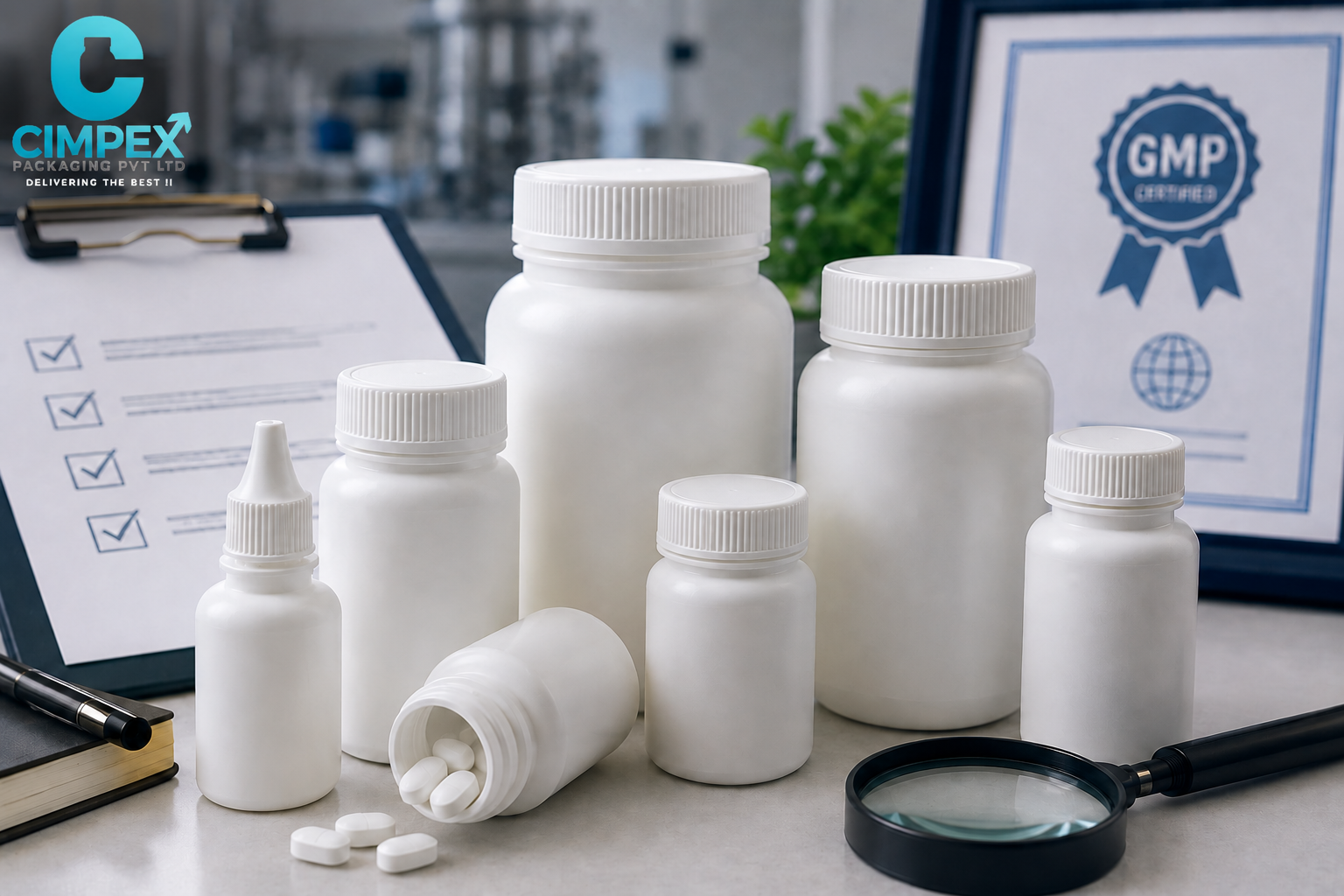
If you manufacture tablets, capsules, syrups, or nutraceutical formulations, the pharma bottle manufacturer in India you choose directly shapes product stability, regulatory approval timelines, and landed cost per unit. Procurement teams sourcing packaging in 2026 are dealing with tighter GMP audits, stricter USP-VI compliance checks, and longer qualification cycles than they saw five years ago. This pharma bottle manufacturer in India guide walks through exactly what to evaluate — materials, certifications, batch traceability, and audit readiness — so your team can shortlist a supplier with confidence rather than trial and error.
Why Sourcing From the Right Pharma Bottle Manufacturer in India Matters in 2026
Pharmaceutical packaging is not a commodity purchase. A poorly specced bottle can fail a stability study, trigger a recall, or hold up an FDA or CDSCO submission by months. Brands sourcing from a pharma bottle manufacturer in India today are also managing a more complex supply chain: multiple SKUs across tablet, syrup, and nutraceutical lines, shorter lead times demanded by marketing calendars, and auditors who now expect documented evidence, not verbal assurances, at every qualification stage.
This is why more procurement heads are moving away from broker-style suppliers and toward vertically integrated manufacturers who control resin sourcing, mould development, and QC testing under one roof. It shortens the accountability chain when something goes wrong, and it usually shortens lead times too.
There’s also a cost dimension that often gets missed early in sourcing conversations. A pharma bottle manufacturer in India quoting a lower per-unit price on paper can end up costing more once you factor in rework from dimensional inconsistencies, delays from an unqualified mould change, or a failed stability batch that has to be repackaged. Total cost of ownership, not just unit price, is what experienced procurement teams now build into their supplier scorecards.
Regional sourcing also plays a role. Manufacturers based in established pharma packaging hubs — Himachal Pradesh, Gujarat, and parts of Maharashtra among them — tend to have easier access to skilled mould-making talent and established resin supply chains, which translates into more predictable lead times for buyers placing recurring orders.
What to Look for When Evaluating a Pharma Bottle Manufacturer in India
A structured evaluation checklist saves weeks of back-and-forth later. Before you send an RFQ, confirm the following:
- ISO 9001:2015 certification covering the actual manufacturing site, not just the head office
- GMP compliant bottle manufacturer status, with documented SOPs for hygiene, changeover, and contamination control
- USP Class VI or equivalent material certification for resin used in direct-contact pharma packaging
- Drug Master File (DMF) or material traceability records the supplier can hand over during your own regulatory filing
- In-house mould development so tooling changes don’t route through a third party and add weeks to lead time
- Batch-level traceability from resin lot to finished carton
- Capacity to support your MOQ without forcing you into oversized production runs
Any pharma bottle manufacturer in India that hesitates to share documentation against this list should be treated as a red flag, not a negotiating point.
It’s worth running this checklist even against suppliers you’ve worked with for years. Facilities change, ownership changes, and a manufacturer that was fully compliant three years ago may not have kept every certification current. Building a habit of re-verifying documentation annually, rather than only at onboarding, is one of the simplest ways procurement teams reduce late-stage sourcing risk.
Materials and Certifications That Actually Matter
Most pharma-grade bottles in India are moulded from HDPE, chosen for its moisture barrier, chemical resistance, and compatibility with tablets, capsules, and dry syrups. A genuine pharma HDPE bottle supplier will be able to walk you through resin grade, wall thickness, and how each affects oxygen transmission and drop resistance — not just quote a price per thousand units.
Look specifically for:
- USP Class VI compliance on the resin, confirmed with a certificate of analysis, not a website claim
- Neck finish standardisation (common pharma sizes include 24/410 and 28/410) so caps, desiccant closures, and induction seals fit without rework
- Consistent wall thickness across a full production run, verified by dimensional QC, to prevent drop-test failures
- Colour and opacity control for light-sensitive formulations
Buyers exploring our HDPE pharma bottles range can see how these specifications translate into actual product options, from 30 ml tablet containers to 500 ml syrup bottles.
Cap and closure compatibility deserves equal attention. A bottle can meet every material and dimensional spec and still fail in the field if the cap doesn’t seal correctly against humidity or the desiccant insert doesn’t fit the neck finish. Ask any pharma bottle manufacturer in India you’re evaluating whether they test bottle and closure combinations together, not just the bottle in isolation — this single question filters out a surprising number of suppliers who only manufacture bottles and outsource closures without joint validation.
How Does a Pharma Bottle Manufacturer in India Ensure GMP Compliance?
GMP compliance in bottle manufacturing isn’t a single certificate — it’s a system. A serious pharma bottle manufacturer in India will typically maintain:
- A controlled, low-particulate moulding environment with defined cleaning schedules
- Documented raw material intake checks against approved vendor lists
- In-process QC at defined intervals during every production run, not just at the end
- Retained samples from each batch for a defined period after dispatch
- Change-control procedures so a mould or resin change is documented and re-qualified, not made silently
If your current supplier can’t produce these records on request, that’s a bigger risk than price variance ever will be.
Beyond the paperwork, ask how change control actually works day to day. Does a resin substitution require sign-off from quality before it reaches the production floor, or is it a decision left to a shift supervisor? The honest answer to that question tells you more about a pharma bottle manufacturer in India’s real GMP maturity than any certificate on the wall.
Qualification, Audits, and Batch Traceability
Most pharma buyers now run a two-stage qualification process before placing a first commercial order: a documentation review followed by a physical site or virtual audit. During this stage, ask your shortlisted pharma bottle manufacturer in India for:
- A copy of their quality manual and current ISO certificate
- Batch traceability records for a sample lot, resin to finished goods
- Evidence of leak, drop, and dimensional testing on recent production runs
- Details of how deviations and out-of-spec batches are handled
Traceability matters even after the order ships. If a stability issue surfaces eighteen months into a product’s shelf life, you need to trace it back to a specific resin lot and production date — not guess.
Many procurement teams also request a pilot run before committing to a full commercial order. A pilot batch, tested against your own stability protocol rather than the manufacturer’s standard QC, gives you independent confirmation that the bottle performs with your specific formulation — not just in general use. It’s a small additional step that catches compatibility issues long before they become a shelf-life complaint.
Packaging Formats Pharma Buyers Typically Source
A capable pharma bottle manufacturer in India should offer more than a single format. Common formats procurement teams source include:
- Tablet and capsule containers in 15 ml–500 ml capacities with tamper-evident and child-resistant cap options — see our tablet containers range for common specifications
- Syrup and liquid oral bottles with wide-mouth or narrow-neck designs depending on dosing device compatibility
- Nutraceutical and health-supplement jars where opacity and desiccant compatibility matter more than clarity
- Ophthalmic and small-volume parenteral-adjacent containers where neck precision is non-negotiable
Sourcing all of these from one qualified pharma bottle manufacturer in India, rather than splitting the order across multiple vendors, simplifies your own internal audit trail considerably. It also means a single set of batch records, a single audit calendar, and one point of contact when a formulation changes and packaging specs need to be revisited.
Common Sourcing Mistakes Procurement Teams Make
- Chasing the lowest per-unit price without checking whether resin grade is actually USP-VI
- Skipping the site audit because a supplier “seems established”
- Assuming ISO 9001 covers pharma-specific GMP requirements — it doesn’t, on its own
- Not asking for retained samples or batch records until an issue has already occurred
- Underestimating lead time for mould development on a custom neck finish or capacity
Every one of these mistakes is avoidable with a documentation-first sourcing process from the start. Building a simple internal scorecard — certifications, lead time history, defect rate on past orders, and responsiveness during audits — turns supplier selection from a one-time negotiation into an ongoing relationship you can actually manage.
Sourcing Pharma Packaging Right
Choosing a pharma bottle manufacturer in India is ultimately a risk-management decision as much as a procurement one. The right partner brings USP-VI material certification, GMP-documented processes, in-house mould development, and batch-level traceability to the table — not just a competitive quote. Cimpex Packaging, based in Baddi, Himachal Pradesh, manufactures HDPE, PP, and LDPE pharma packaging under ISO 9001:2015 certification, with in-house tooling and QC built specifically around pharma buyer requirements. If your team is finalising a shortlist for 2026, request pharma quote and our packaging team will walk you through specifications, MOQs, and lead times for your exact formulation.
Frequently Asked Questions
What certifications should a pharma bottle manufacturer in India hold?
At minimum, ISO 9001:2015, GMP-documented processes, and USP Class VI material certification for resin used in direct-contact pharma packaging.
What is the typical MOQ for pharma bottles in India?
MOQs vary by manufacturer and mould availability, typically starting in the range of a few thousand units for standard neck sizes and capacities.
Can a pharma bottle manufacturer in India develop a custom bottle design?
Yes, manufacturers with in-house mould development can create custom capacities, neck finishes, and shapes, though this adds lead time versus stock tooling.
How long does supplier qualification usually take?
Documentation review typically takes 1–2 weeks; a full audit and sample qualification cycle can run 4–8 weeks depending on your internal QA process.
Is HDPE suitable for all pharma packaging formats?
HDPE suits tablets, capsules, and dry powders well due to its moisture barrier; liquid formulations may need alternate neck or cap sealing solutions.
What is batch traceability and why does it matter?
It’s the ability to trace a finished bottle back to its resin lot and production date, essential for investigating any stability or quality issue post-dispatch.
Do pharma bottle manufacturers in India export internationally?
Many established manufacturers, including ISO-certified facilities, do export, though buyers should confirm specific country regulatory documentation separately.