


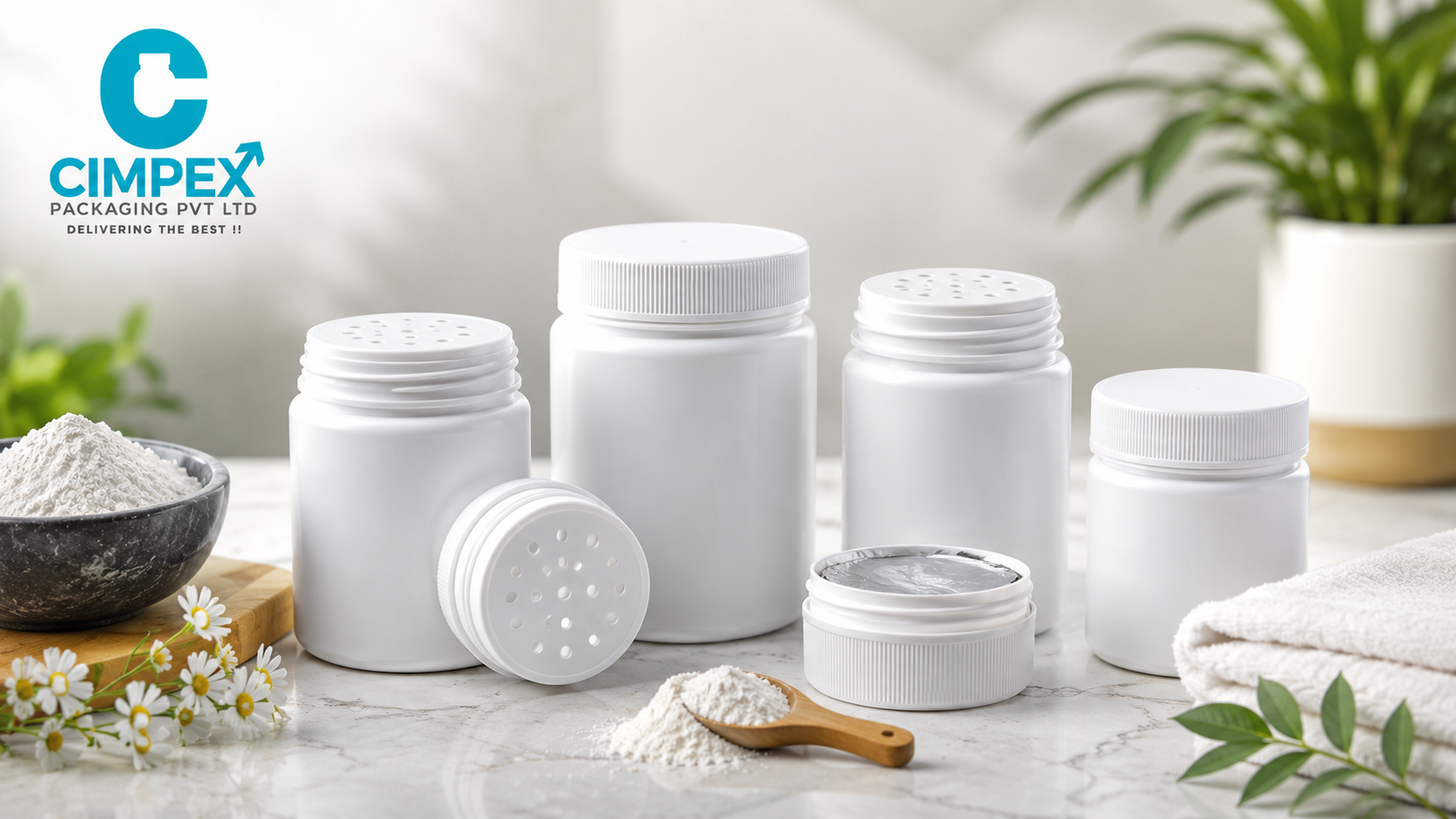
Powder is one of the least forgiving fills in plastic packaging a jar that lets in a trace of moisture, or a sifter cap that clumps after three weeks on a humid shelf, undoes months of formulation work. That’s why choosing the right powder jar manufacturer in India matters more than most brands realise until something goes wrong post-launch. Food-grade HDPE jars solve most of the common failure points, but only when the resin grade, cap system, and moisture-barrier design are specified correctly from the start.
Cimpex Packaging manufactures powder jars in food-grade HDPE for talcum, ayurvedic, nutraceutical, and cosmetic powder formulations, all moulded in-house in Baddi, Himachal Pradesh. This guide covers what a genuinely food-grade powder jar manufacturer in India should be able to explain clearly, and what to check before you commit to a production order.
What Makes an HDPE Jar “Food-Grade”?
Not every HDPE jar on the market qualifies as food-grade, even when the resin looks identical to the naked eye. A credible powder jar manufacturer in India should be able to confirm:
- Virgin resin, not reground material food-grade jars must use virgin HDPE, since reprocessed or regrind resin can carry contamination from prior use.
- FSSAI-compliant material sourcing for jars intended for edible or ingestible powders sold in India.
- No pigment migration risk colourants used in food-contact jars must be approved for that contact category, not general-purpose masterbatch.
- Odour-neutral moulding properly processed HDPE shouldn’t impart any plastic taste or smell to a dry powder fill, which is a common giveaway of poor resin quality.
Sifter vs Sprinkler vs Screw Cap: Choosing the Right Closure
The closure system matters as much as the jar body for powder applications, because dispensing control is usually the biggest complaint point for end users.
Sifter Caps
Best for talcum powder, foot powder, and cosmetic setting powders where the user wants a light, even dusting rather than a controlled stream.
Sprinkler/Spice-Style Caps
Suited to ayurvedic or nutraceutical powders dispensed in small measured amounts often paired with a flip-top or hinged lid to control flow more precisely than an open sifter.
Plain Screw Caps with Induction Seal
Common for bulk nutraceutical powder jars where the end consumer scoops rather than sprinkles, and where a tamper-evident induction seal is required for shelf trust.
How Does a Powder Jar Prevent Moisture Ingress?
This is the question that separates a functional powder jar manufacturer in India from one that’s simply moulding a generic container and hoping it works. Moisture control comes from three design elements working together, not any single feature:
- Wall thickness and resin density HDPE is naturally a good moisture barrier, but thin-walled jars (under 0.7 mm) lose some of that advantage, especially in humid coastal climates.
- Cap sealing geometry a properly engineered lip-and-groove seal on the jar neck, matched precisely to the cap’s inner ring, does more to stop moisture ingress than resin choice alone.
- Induction seal liner for hygroscopic powders (many ayurvedic and nutraceutical formulations absorb moisture readily), an induction-sealed foil liner under the cap is close to essential, not optional.
Standard Sizes and Capacity Range
A powder jar manufacturer in India typically stocks or tools jars across this rough capacity range, though exact figures vary by supplier:
- 50 g – 100 g: Small cosmetic or sample-size powder jars
- 100 g – 250 g: The most common range for talcum and ayurvedic powders
- 250 g – 500 g: Family-size or value-pack formats for nutraceutical and household powder products
- 500 g and above: Bulk or institutional supply, often paired with scoop inserts
Explore the full HDPE jars range and nutraceutical jars category to compare standard capacities before specifying a custom size.
Powder Jars vs Powder Bottles: What’s the Real Difference?
Brands often use “jar” and “bottle” interchangeably for powder packaging, but the distinction matters functionally. A jar typically has a wider mouth relative to its height, which suits sifter or sprinkler dispensing and easier scooping. A narrower-necked format closer to what you’d see from a talcum powder bottle manufacturer favours a controlled sprinkle-through-holes dispensing pattern rather than scooping. Choosing between the two comes down to how the end consumer is meant to use the product, not just brand aesthetics.
Industries That Rely on Food-Grade Powder Jars
- Cosmetic and personal care: talcum, setting powder, foot powder
- Ayurvedic and herbal: churna, herbal powder blends, traditional formulations
- Nutraceutical: protein powders, supplement blends, functional food powders
- Home care: cleaning or scouring powders where food-grade isn’t required but moisture control still is
Manufacturing Process: How Powder Jars Are Actually Made
Understanding the moulding process helps explain why some jars perform better than others in the field. A powder jar manufacturer in India producing to food-grade standard typically follows an injection-moulding process for the jar body, since injection moulding gives tighter dimensional control on wall thickness and neck sealing geometry than extrusion blow moulding does for wide-mouth formats. The process runs in stages:
- Resin drying and loading HDPE pellets are dried to remove residual moisture before melting, since trapped moisture in the resin itself can create surface defects.
- Injection into the cavity molten resin is injected under controlled pressure into a precision-machined mould cavity shaped to the jar body and threaded neck.
- Cooling and ejection the jar cools inside the mould before ejection, with cooling time tuned to avoid warping on wide-mouth designs.
- Trimming and QC inspection gate marks are trimmed, and dimensional checks confirm neck thread engagement matches the cap supplier’s tolerance.
- Cap and liner assembly sifter, sprinkler, or screw caps are fitted, with induction liners applied where the fill requires moisture protection.
A powder jar manufacturer in India that controls every one of these stages in-house, rather than outsourcing cap assembly to a third party, tends to catch fit and seal issues before they reach a customer’s fill line.
Cost Factors When Sourcing Powder Jars
Pricing from a powder jar manufacturer in India depends on more than raw material cost alone. The main variables worth understanding before you compare quotes:
- Resin grade food-grade virgin HDPE costs more than commercial-grade or reground resin, and the price difference is a legitimate quality signal, not just margin.
- Wall thickness thicker walls for humid-climate shipping or export use more resin per unit.
- Closure complexity a simple screw cap costs less than a sifter-and-induction-seal combination.
- Order volume per-unit cost drops meaningfully at higher volumes once tooling and setup costs are spread across more units.
- Custom vs stock tooling a stock jar shape from an existing mould library is always cheaper than a newly tooled custom capacity or silhouette.
Checklist Before You Order From a Powder Jar Manufacturer
- Confirm resin is virgin, food-grade HDPE with documentation, not a verbal assurance
- Specify sifter, sprinkler, or screw-cap closure based on actual end-use behaviour
- Request an induction-seal option if the powder is hygroscopic
- Ask for a real humidity-exposure sample test, not just a sealed-jar visual check
- Confirm wall thickness suits your shipping and shelf-life requirements
- Check minimum order quantity against your production volume before committing
Shelf-Life Testing and Real-World Validation
Before committing to a full production order, ask any powder jar manufacturer in India to run or share results from a real humidity-exposure test rather than relying on resin data sheets alone. A jar that seals visually can still allow slow moisture transfer through micro-gaps in the cap-to-neck interface, and this only shows up after several weeks on shelf, not on day one. Requesting a filled sample batch stored at elevated humidity for two to four weeks, then checked for clumping or texture change, is a low-cost way to catch a seal design flaw before it reaches thousands of retail units.
Final Thoughts
A reliable powder jar manufacturer in India treats moisture control and food-grade compliance as engineering requirements, not marketing claims the resin grade, cap seal geometry, and induction liner all have to work together, or the jar looks fine on day one and fails by week three on a humid shelf. If you’re specifying a new powder format, request powder-jar specs with your formulation details so the closure and seal can be matched correctly from the start.
Frequently Asked Questions
What makes an HDPE powder jar food-grade?
It must use virgin (not reground) resin, FSSAI-compliant sourcing for edible fills, and approved colourants with no risk of odour or pigment migration.
Which cap type is best for talcum powder?
Sifter caps are the standard choice for talcum powder, giving an even, light dusting rather than a controlled stream or scoop format.
Do powder jars need an induction seal?
Hygroscopic powders like many ayurvedic and nutraceutical blends benefit strongly from an induction-sealed foil liner to block moisture ingress under the cap.
What sizes do powder jars typically come in?
Common capacities range from 50 g sample jars up to 500 g and above for bulk or family-pack nutraceutical and household powder products.
What’s the difference between a powder jar and a powder bottle?
Jars have a wider mouth suited to scooping or sifting; bottles have a narrower neck suited to controlled sprinkle-through-hole dispensing.
Can a powder jar manufacturer in India supply custom capacities?
Yes most manufacturers offer custom mould development for non-standard capacities once volume justifies the tooling investment.
How do I know if my powder formulation needs moisture-barrier packaging?
If the powder clumps, cakes, or changes texture when exposed to humid air, it’s hygroscopic and needs an induction seal plus adequate wall thickness.
Should I choose a powder jar manufacturer in India over an overseas supplier?
A domestic powder jar manufacturer in India shortens lead time for sample iteration and lets you physically test seal performance before committing to a large order.