


What Makes a Bottle “Wide Mouth”
A wide mouth HDPE bottle is defined by its neck finish rather than its overall shape. Instead of a narrow neck designed for pouring liquids, the opening is sized closer to the bottle’s body diameter, making it easy to fill, scoop from, or insert tablets, capsules, powders or bulky granules directly. This design choice affects almost every downstream decision from the capping system to the filling line speed. Wide mouth HDPE bottles are typically specified with neck finishes ranging from around 28mm up to 63mm or larger, depending on the product being packaged. A talcum powder container, for instance, may use a different neck opening than a nutraceutical tablet jar, even though both fall under the same “wide mouth” category.Why HDPE Is the Preferred Material
High-density polyethylene brings a specific combination of properties that make it a natural fit for wide mouth packaging:- Strong resistance to moisture ingress, which matters when the contents are hygroscopic powders or supplements
- Good chemical resistance against acids, alkalis and many solvents, useful for industrial and agrochemical fills
- Durability under stacking and transport stress, reducing breakage during bulk shipping
- Compatibility with a wide range of closures, including sifter caps, flip-tops and child-resistant designs
HDPE Bottle Sizes for Wide Mouth Packaging
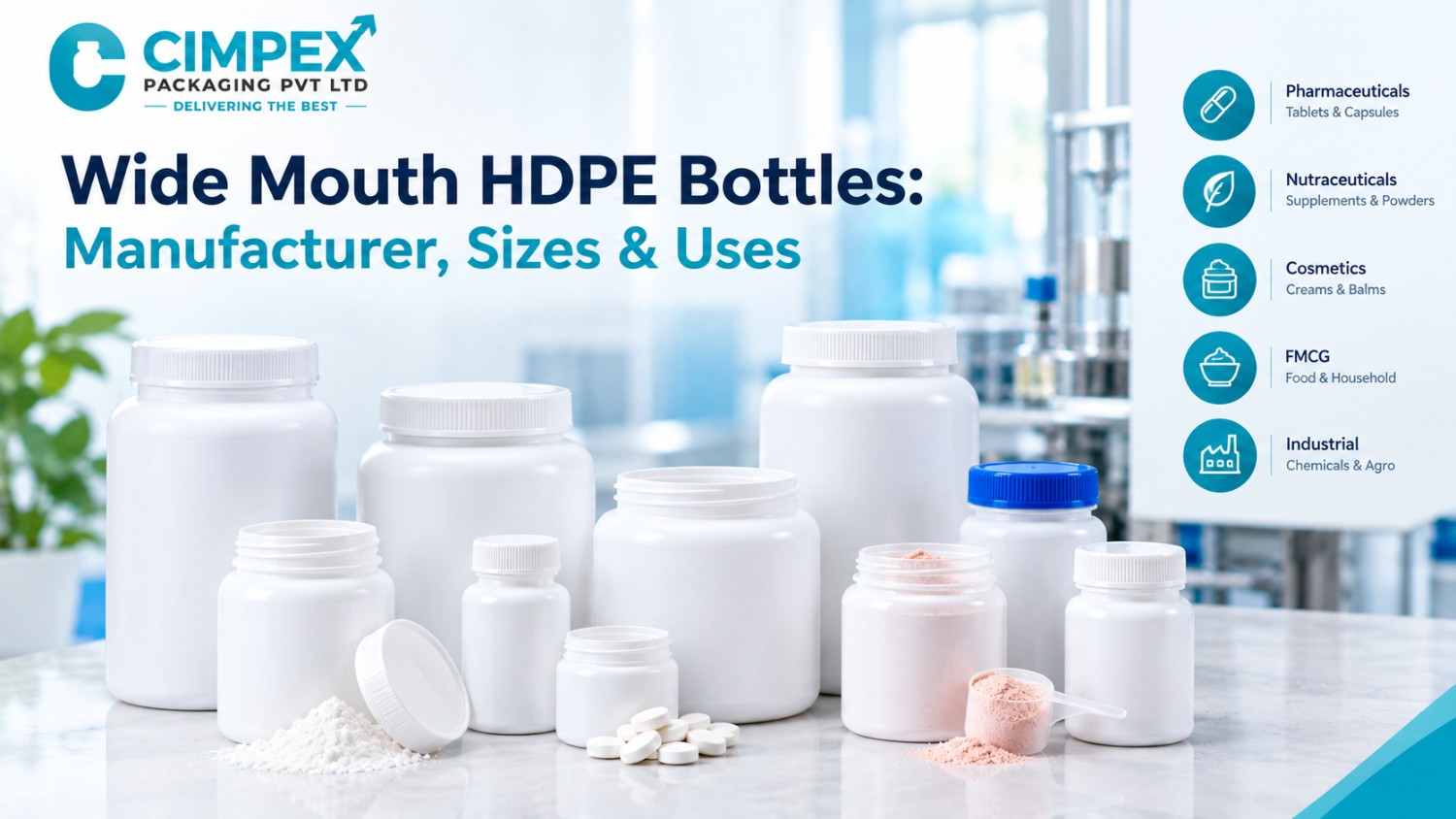
One of the most common questions procurement teams ask is what HDPE bottle sizes are actually available. The honest answer is that the range is broad, because wide mouth bottles serve everything from single-dose formats to bulk industrial containers. Typical volumes seen across the industry run from around 30ml jars used for small nutraceutical or cosmetic fills, up to 500ml, 1 litre and larger sizes used for bulk powders, protein blends or industrial compounds. Within each volume band, brands can usually choose between round, square or custom-shaped bodies, along with a matching cap size. If you’re unsure which HDPE bottle sizes fit your product volume and dosage requirements, sharing your fill weight and expected shelf presentation with your manufacturer upfront saves several rounds of sampling later.Applications and Industries
Wide mouth HDPE bottles are not a niche product they show up across a surprisingly wide set of industries, each with its own priorities.HDPE Bottles for Pharmaceutical Packaging
In pharma, HDPE bottles for pharmaceutical packaging need to satisfy more than aesthetics. Tablet and capsule containers require consistent wall thickness for moisture barrier performance, compatibility with desiccants, and closures that meet child-resistant or tamper-evident standards where applicable. A wide mouth format makes it easier for patients, especially elderly users, to retrieve tablets without fumbling, and it simplifies automated counting and filling on pharmaceutical production lines.HDPE Bottles for Powders
When it comes to HDPE bottles for powders, the wide opening is not a convenience feature, it’s often a functional necessity. Talcum powder, dusting powder, protein and nutraceutical powders, and certain agrochemical powders all require an opening large enough for a scoop or sifter cap to work properly. Moisture resistance becomes especially important here, since many powders cake or clump when exposed to even small amounts of humidity.Wide Mouth Plastic Container Use in Cosmetics and FMCG
Beyond pharma, a wide mouth plastic container is a familiar sight on cosmetics shelves think body butters, balms, and thick creams that need to be scooped rather than poured. FMCG brands also rely on wide mouth HDPE packaging for items like protein powders, bath salts, and certain food products where visual merchandising and ease of use both matter.Industrial and Agrochemical Use
On the industrial side, wide-mouth HDPE containers are used for solid or semi-solid chemical compounds, granular fertilisers, and certain lubricant additives where operators need to scoop measured quantities rather than pour a liquid.Choosing the Right Wide Mouth HDPE Bottles for Your Product
Selecting the right bottle isn’t only about picking a size off a catalogue. A few practical factors decide whether the packaging performs well in the real world:- Fill weight and density – A bottle sized correctly by volume may still look underfilled or overfilled if the product’s density wasn’t accounted for during sizing
- Neck and cap compatibility – Sifter caps, flip-top lids and screw caps all require slightly different neck tolerances, so confirm compatibility before finalising the mould
- Moisture sensitivity of the product – Hygroscopic powders may need a tighter sealing cap or an added induction seal liner
- Regulatory requirements – Pharmaceutical and certain FMCG categories may require specific closure standards, so check applicable norms early in development
HDPE Bottle Packaging: Standard vs Custom Development
Most brands starting out choose from an existing catalogue of wide mouth HDPE bottles to avoid tooling costs and lead time. As volumes grow, however, many move toward custom-moulded shapes that better reflect brand identity on the shelf. The table below outlines the practical trade-offs.| Factor | Standard Catalogue Bottle | Custom-Moulded Bottle |
| Lead time | Available quickly, often from existing stock moulds | Typically 3–4 weeks from approved design to first sample |
| Tooling cost | None | One-time mould development cost |
| Minimum order quantity | Lower, generally more accessible for new brands | Higher, to justify tooling investment |
| Design flexibility | Limited to existing shapes and neck sizes | Full control over shape, embossing and neck finish |
| Best suited for | Early-stage brands, smaller batches, quick market testing | Established brands scaling volume with a distinct identity |
Sustainability of Wide Mouth HDPE Bottles
HDPE carries resin identification code 2 and is among the more widely recycled plastics in commercial use, which matters increasingly to brands under pressure to demonstrate responsible packaging choices. A wide mouth format doesn’t change the base material’s recyclability, but it does affect how easily consumers can rinse out residual product before disposal a wider opening genuinely helps here compared with a narrow neck, particularly for thicker creams and powders that tend to cling to bottle walls. Brands looking to strengthen their sustainability story sometimes pair wide mouth HDPE bottles with post-consumer recycled resin blends, though it’s worth confirming with your manufacturer how PCR content affects clarity, colour consistency and mechanical strength before committing to a blend for a live production run.Common Mistakes to Avoid
- Choosing a neck size based only on cap availability rather than product flow and scoop compatibility
- Ignoring UV exposure during storage, which can affect standard-grade HDPE over long periods
- Underestimating lead times for custom moulds and leaving no buffer before a launch date
- Skipping sample testing with the actual product before committing to a bulk production run
Conclusion
Wide mouth HDPE bottles remain one of the most practical packaging choices for powders, creams, tablets and a range of industrial fills, largely because the format solves a real usability problem while HDPE itself delivers the durability and chemical resistance that these products demand. Whether you’re packaging a pharmaceutical powder, a nutraceutical blend, or an industrial compound, the details neck size, cap compatibility, moisture protection and manufacturing partner decide how well the packaging performs once it leaves the factory. If you’re evaluating HDPE bottle packaging for an upcoming launch or reformulation, it’s worth mapping your fill weight, product density and closure requirements before requesting samples, so the manufacturer can recommend the right neck size and material grade from the outset. A short conversation with an experienced supplier at this stage usually prevents costly resizing later in development. According to the U.S. EPA’s overview of plastic resin types, HDPE (resin code 2) remains one of the most widely recycled plastics in commercial use, reinforcing why it continues to be a preferred packaging material across pharmaceutical and consumer categories.Frequently Asked Questions
Wide mouth HDPE bottles have a neck opening close to the body diameter, ideal for powders, creams and tablets that need scooping or easy access. Narrow mouth bottles are designed for pouring liquids and typically use a smaller neck finish with different capping options.
Sizes typically range from around 30ml for small cosmetic or nutraceutical jars up to 1 litre or larger for bulk powders and industrial fills. Manufacturers can usually also develop custom volumes for specific brand or dosage requirements.
Yes, wide mouth HDPE bottles are widely used for tablets, capsules and pharmaceutical powders because they support consistent moisture barrier performance and are compatible with child-resistant and tamper-evident closures.
Most manufacturers offer custom colours, embossing, and mould development for unique shapes and neck sizes, though custom moulds typically involve a higher minimum order quantity than standard catalogue bottles.
Yes, provided the cap and liner are selected correctly. A sifter cap or an induction-sealed closure paired with a properly sized wide mouth bottle significantly reduces moisture ingress and caking during storage.
Look at their material sourcing, quality testing process, sample availability, minimum order quantities, and turnaround time for custom moulds. Asking for a data sheet and a physical sample before bulk ordering is good practice.
If you’re testing a new product or working with lower volumes, a standard catalogue bottle keeps costs down. Once volumes justify the tooling investment and brand differentiation becomes a priority, a custom mould is usually the better long-term choice.