


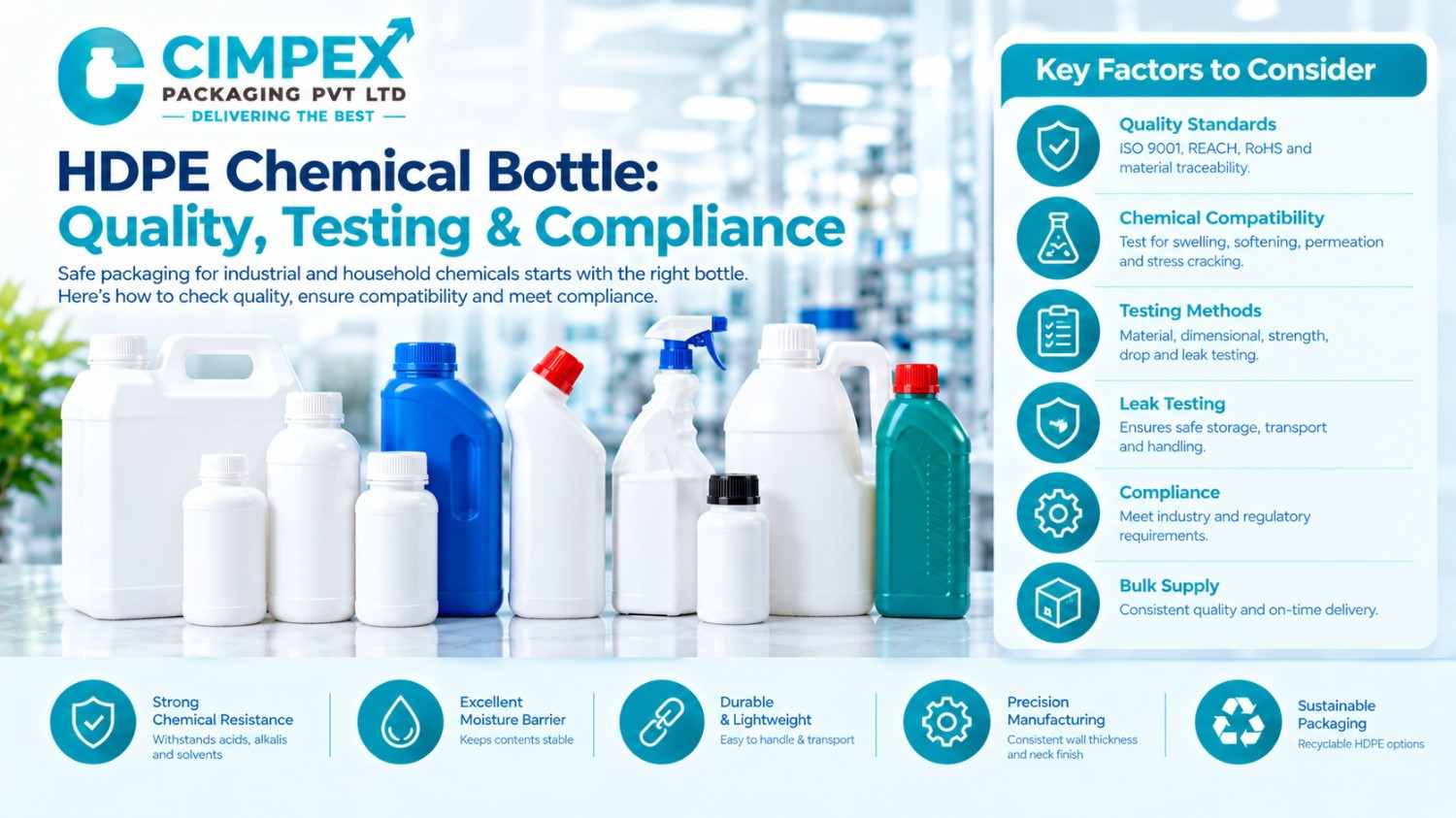
An HDPE chemical bottle is only as reliable as its material, its dimensions and the seal formed with its closure. HDPE resists many acids, alkalis and solvents, but not every chemical in every condition, and a bottle that suits one formulation may fail with another. This guide explains how to judge HDPE chemical bottle quality, which standards and tests matter, how to assess chemical compatibility and how leak testing confirms that a pack is safe to ship and store.
Chemical products add risk that ordinary packaging does not carry. A leaking bottle can damage goods, harm handlers and create regulatory trouble. That is why chemical packaging deserves a documented quality process, not a visual approval.
Why HDPE Is Widely Used for Chemical Packaging
HDPE is a common choice for chemical containers because it is tough, lightweight and resistant to many substances. The general reference on chemical compatibility explains that materials differ in how they react to chemicals, which is exactly why packaging needs to be matched to the contents. Cimpex Packaging describes its HDPE bottles as made from virgin resin with resistance to acids, alkalis, alcohols and most solvents, strong moisture resistance and a wide size range from roughly 30 ml to 5 litres.
Typical uses include household and industrial cleaners, agrochemicals and pesticides, lubricants and automotive fluids. Each of these has different demands. A toilet cleaner, a pesticide concentrate and a lubricant stress the bottle in different ways, so the same bottle should not be assumed to suit all three.
HDPE Chemical Bottle Quality Standards
HDPE chemical bottle quality standards work in layers. No single certificate covers everything.
- Quality management: ISO 9001 shows that a documented, audited system exists. Cimpex Packaging lists ISO 9001:2015.
- Material compliance: Resin should come from controlled, traceable sources with documentation on request. Export markets may require REACH and RoHS compliance, both of which Cimpex Packaging lists.
- Dimensional specifications: The drawing should define neck finish, wall thickness, weight and capacity with acceptance limits.
- Transport and labelling rules: Some chemicals need packaging approved for dangerous goods transport, and labelling rules vary by market.
HDPE chemical bottle quality standards support your compliance but do not replace it. The brand remains responsible for confirming that the finished pack meets the rules for its own product, so involve your regulatory adviser early.
HDPE Bottle Chemical Compatibility
HDPE bottle chemical compatibility is the most important question for a chemical pack, and also the one most often assumed rather than tested. Compatibility covers more than whether the bottle dissolves. It includes swelling, softening, discolouration, permeation through the wall, loss of strength and stress cracking over time.
Factors That Affect Compatibility
- Chemical type: Strong oxidisers, certain solvents and some concentrated products affect HDPE differently from mild cleaners.
- Concentration and temperature: Compatibility can change significantly when concentration or storage temperature rises.
- Exposure time: A short test may not reveal a problem that appears after months of storage.
- Additives and fragrances: Surfactants, solvents and fragrances can behave differently from the base chemical.
- Stress: Bottles under load or closure stress may crack where an unstressed sample would not.
Stress cracking, formally environmental stress cracking, matters for detergents and similar products because a bottle can pass a quick visual check and still crack in service. Cimpex Packaging reports testing for stress cracking along with drop, leak and top-load performance.
The safest approach for any HDPE chemical bottle is to test your own formulation in the actual bottle and closure under realistic storage conditions, and to keep the results on file.
HDPE Chemical Bottle Testing
HDPE chemical bottle testing combines checks on the bottle itself with tests that simulate real use. A balanced programme includes the following.
Material and Dimensional Checks
Incoming resin is checked for properties such as melt flow index, density and purity. Finished bottles are measured for neck dimensions, thread accuracy, weight and wall thickness, because uneven walls reduce strength and the neck decides the seal. Cimpex Packaging describes in-house laboratory sampling of each batch for these dimensional factors.
Strength and Handling Tests
Top-load tests show whether bottles survive stacking. Drop tests show whether they survive handling. For heavier chemical packs, these tests are especially important, because a failure releases more product.
Compatibility and Storage Trials
Fill sample bottles with the real product, seal them with the intended closure and store them under controlled conditions, including elevated temperature if relevant. Inspect for deformation, weight loss, colour change, odour and stress cracks at agreed intervals. Where formal methods apply, organisations such as ASTM and ISO publish standard procedures for chemical resistance and container performance, and your quality team can select those that fit your product.
HDPE Chemical Bottle Leak Testing
HDPE chemical bottle leak testing confirms that the bottle and closure hold the product without seepage. For chemicals this is a safety requirement, not a convenience.
- Test the assembled pack: Bottle, closure and liner or seal together decide the result.
- Control closing torque: Over-tightened caps can crack, while under-tightened caps leak.
- Repeat after stress: Drop, vibration, stacking and temperature exposure often reveal weaknesses that a bench test misses.
- Check venting needs: Some products release gas, so the closure may need a vent or other design.
- Record results: Documented results support audits and customer complaints.
Cimpex Packaging lists leak and drop checks among its tests, though the page does not publish the method or pass criteria. If the details matter to your product, ask for them in writing.
Chemical Packaging Bottles: Matching the Pack to the Product
Chemical packaging bottles differ by application, and the best design depends on what is inside.
| Factor | Household cleaners | Agrochemicals and pesticides | Lubricants and industrial fluids |
| Main concern | Closure safety and handling | Leak safety and chemical resistance | Strength and larger volumes |
| Closure | Child-resistant or flip-top options | Secure screw cap with liner | Secure cap, sometimes with pouring spout |
| Design focus | Grip, pouring, labelling | Measuring, safety and visibility of warnings | Capacity, handle and stacking strength |
| Verification | Compatibility and leak tests | Compatibility, stress crack and leak tests | Strength, drop and leak tests |
Cimpex Packaging also notes that standard HDPE offers basic UV resistance and that UV-stabilised grades are available on request, which can matter for products stored outdoors or in bright warehouses.
Closures, Labelling and Safety Features
The closure is part of the safety system. For hazardous household and agrochemical products, child-resistant and tamper-evident closures may be required or advisable, and Cimpex Packaging notes that its bottles are compatible with both. Liners improve sealing, while some products need vented caps to release pressure. Labelling matters as well: the bottle surface must accept the chosen label, shrink sleeve or print so that hazard information stays legible through handling and storage. Check that label adhesives and inks do not react with the contents if spillage is likely, and confirm the labelling rules for your market with your adviser.
Storage, Handling and Shelf Life
A well-made HDPE chemical bottle can have a long service life when stored cool, dry and away from direct sunlight, according to Cimpex Packaging’s own guidance, but the contents decide the practical shelf life. Heat accelerates both chemical attack and stress cracking, so warehouses with high summer temperatures deserve extra attention. Stack bottles within their tested top-load limits, keep cartons dry and avoid storing partly filled bottles for long periods, since vapour and residue can interact with the closure. Record the storage conditions used in your compatibility trials so that the same conditions are applied in the field.
How to Choose an HDPE Chemical Bottle
Use this checklist:
- Define the product: Record the chemical, concentration, pH, temperature and shelf life.
- Specify the bottle: Define capacity, neck finish, wall requirements and colour or UV needs.
- Choose the closure: Consider child-resistance, tamper evidence, liners and venting.
- Run compatibility trials: Test the real formulation in the real pack.
- Verify quality documents: Request certificates, Certificates of Analysis and traceability records.
- Confirm compliance: Check labelling, transport and market rules with your adviser.
Common Mistakes to Avoid
- Assuming HDPE suits every chemical: Compatibility depends on the formulation and conditions.
- Testing the bottle without the closure: Many leaks come from the closure, not the bottle.
- Using short trials only: Stress cracking and permeation can take time to appear.
- Ignoring temperature: Warehouse heat changes how chemicals and plastics interact.
- Skipping documentation: Without records, you cannot trace or prove what you shipped.
Conclusion
A dependable HDPE chemical bottle depends on three things working together: a controlled quality system, proven compatibility with the product and a closure that seals under real conditions. Verify documents and certifications, test the real formulation in the real pack, and treat leak testing as a safety check rather than a formality.
If you are planning a chemical packaging project, write down the product, concentration, storage conditions, closure type and compliance requirements before you contact suppliers. Explore the Cimpex Packaging range of HDPE bottles, or contact the team to discuss samples and documentation for your application.
Frequently Asked Questions
An HDPE chemical bottle is a container made from high-density polyethylene for storing liquids such as cleaners, agrochemicals, lubricants and industrial fluids. HDPE resists many acids, alkalis and solvents, but suitability still depends on the specific product and storage conditions.
No. HDPE resists many acids, alkalis, alcohols and solvents, but some strong oxidisers and certain solvents can affect it, especially at high concentration or temperature. Test your own formulation in the actual bottle and closure before approving a pack.
Common standards include ISO 9001 quality management, resin traceability and compliance documents, defined dimensional specifications and market-specific rules such as REACH, labelling and dangerous goods transport requirements where relevant. Confirm what applies with your regulatory adviser.
Testing combines resin checks, dimensional and weight measurement, visual inspection, top-load and drop tests, stress-crack evaluation, compatibility trials with the real product and leak testing of the assembled pack. The exact programme depends on the chemical and market.
Fill sample bottles with your actual formulation, seal them with the intended closure and store them under realistic and elevated temperatures. Inspect at set intervals for deformation, weight loss, discolouration, odour and stress cracks, and keep the results on file.
Chemical packaging bottles hold household cleaners, pesticides and agrochemicals, lubricants, sanitizers and industrial fluids. Each use needs the right capacity, closure, strength and chemical resistance, so the bottle should be selected for the specific product, not chosen by size alone.
Leak testing seals the bottle with its closure and checks for liquid loss or air escape using inversion, pressure or vacuum methods. Test the assembled pack, control closing torque and repeat after drop, vibration or temperature exposure to confirm the seal holds.